+971-8000321216



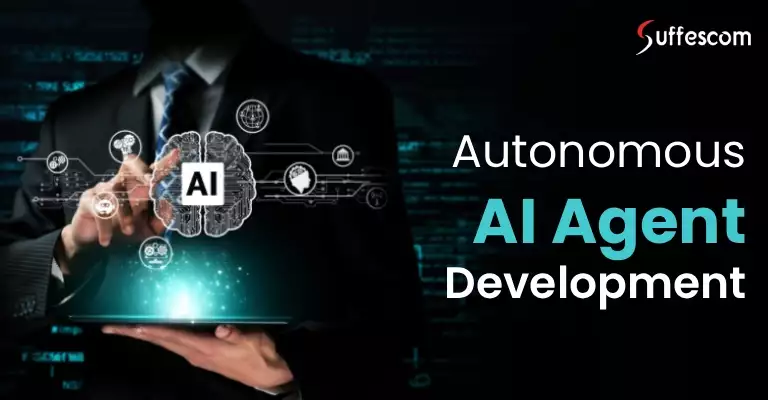
Building intelligent systems that can think, decide & act on their own once felt like a concept limited to science fiction. Now, it is actually turning into a major source of competitive advantage for businesses of all types. From automating complex workflows to making real-time decisions, autonomous AI agents are reshaping how organizations operate, innovate, as well as scale.
However, creating an autonomous AI agent for business use is not as simple as plugging in a model along with expecting results. Numerous organizations invest heavily in AI initiatives but struggle to move beyond basic automation. Without ideal strategy, the right architecture & proper alignment with business goals, even powerful AI systems can fall short of delivering real value.
Today's businesses demand intelligent systems that can learn from data, adapt to changing conditions, plus execute tasks independently with minimal human intervention. This is where autonomous AI agent development solutions come in. These agents go beyond simple task execution. They continuously learn, improve & respond dynamically to real-world scenarios.
Unlock the Power of Automation with AI Agents Built by Industry Experts!
What is an AI Automation Agent?
An AI automation agent is a smart software program that can perform tasks on its own using artificial intelligence, without needing constant human instructions.
In simple words, it's like a digital assistant that not only follows instructions but also thinks, learns, as well as takes actions automatically based on queries. It functions:
- Understand data (text, voice, or images)
- Make decisions based on rules or learning
- Take actions to complete tasks
- Learn & improve over time
Working of Autonomous AI Agent: Understanding the Architecture Behind the Intelligence
AI agents operate based on a well-defined, organized set of steps that enable them to understand data, make decisions & execute tasks in an automated fashion. The technology behind them is complex, but the way they work is logical, just like how humans understand, think, decide & learn. Look at how AI automation agent development services operate in a business environment:
Data Collection and Input Processing
An AI agent begins by handling several data formats, including:
- Structured data (such as databases)
- Unstructured data (such as emails & chats)
- Live feeds
By merging such data, the agent creates an accurate, up-to-date view of the task or situation.
Data Analysis & Decision Making
After data acquisition, the agent processes it using technologies such as machine learning, as well as natural language processing. During these phases, the system:
- Identifies patterns
- Understands context
- Evaluates possible outcomes
Based on predefined rules & learned insights, the AI agent selects the most appropriate action that aligns with business objectives.
Task Execution & Automation
Once a decision is made, the AI agent automatically carries out the task. This could consist of:
- Replying to queries
- Scheduling actions
- Updating systems
- Triggering workflows
The main goal of an autonomous AI agent is to finish tasks efficiently while maintaining accuracy, along with consistency across operations.
Continuous Learning & Improvement
AI agents improve over time by learning from the outcomes of their actions. After each task, they:
- Analyze results
- Update their understanding
This continuous feedback loop enables the agent to generate new ideas, plus raises its level, even without frequent human intervention.
Integration with Business Systems
AI agents can connect with existing tools such as:
- CRM
- ERP
- Communication platforms
This makes it possible for data to flow smoothly between the two systems, plus overcome the need for manual team coordination.
Types of AI Agents Used in Business
Explore the popular kinds of autonomous AI systems to streamline modern business operations:
Simple Reflex Agents: These are the most basic type of AI agents. They are rule-based & act according to predefined rules that help them recognize specific situations, plus react in a predetermined way. It helps businesses in:
- Basic customer support chatbots
- Automated responses (e.g., answering FAQs or routing queries)
Model-Based Agents: Recognize the environment by building an internal model; this way, they make better decisions based on the past & current data. Helpful in systems, like:
- Inventory management
- Supply chain tracking (where the agent needs to understand the current state before taking action)
Conversational AI Agents: These autonomous systems interact with users through natural language (text or voice) & handle complex conversations. Helps in:
- Customer support
- Virtual assistants
- HR helpdesks
- Sales inquiries to provide real-time assistance
Goal-Based Agents: Goal-based agents make decisions by focusing on achieving specific business objectives. They evaluate different actions & choose the one that best meets the goal. It creates business value by:
- Sales automation
- Marketing campaigns (where the goal is to maximize conversions, leads, or engagement)
Learning Agents: Improve their performance over time by analyzing data & outcomes. They adapt based on experience without needing constant reprogramming. It helps businesses by:
- Recommendation systems
- Fraud detection
- Predictive analytics (where continuous improvement is essential)
Utility-Based Agents: These agents go a step further by not only achieving goals but also optimizing outcomes against defined metrics such as cost, time, or efficiency. Commonly used in:
- Pricing strategies
- Logistics optimization
- Financial decision-making (involves balancing multiple factors)
Autonomous (Multi-Step) Agents: These are advanced AI agents that can plan, execute, as well as manage several tasks independently across systems. Enterprise uses these for end-to-end process automation, such as:
- Handling customer onboarding
- Managing workflows
- Coordinating operations across departments
Turn Your Vision into Reality with AI Agents Engineered by Experts!
Top Reasons: Why Autonomous AI Agents are Gaining Popularity in Business Automation
Autonomous AI agents are becoming popular in business settings because they provide several advantages for running operations and increase productivity. Explore the following:
- Reduction in Manual Work: These systems automate several repetitive tasks, such as data entry, query answering, along with application processing. We build autonomous AI agents that not only manage these tasks but also free up human resources to be deployed to more important as well as challenging activities.
- Quicker Decisions: AI agents are capable of sifting through huge volumes of data within seconds and can share the analytical findings on the spot. As a result, this allows businesses to make swift & well-informed decisions.
- Data-Driven Insights: Organizations produce tremendous amounts of data every minute, but are not using it to its full potential. AI agents will go through the data & generate insights to support business strategies.
- Enhanced Productivity: AI delegates and decentralizes work by reducing physical human intervention in workflows, facilitating harmonious teamwork & decreasing errors in final outputs.
- Easy Integration with Existing Systems: Our autonomous AI systems development solutions are easily integrated with tools such as CRM, ERP & other business software platforms. This allows companies to take advantage of automation without larger changes to their current systems.
- 24/7 Operation: These systems can operate continuously without breaks, unlike humans. This is often needed in customer support, system monitoring, along with a worldwide business context.
- Cost-effective Growth: As businesses expand, accommodating more work typically requires more resources. AI agents are able to cope with the growth in the volume of work without the costs rising in proportion, thereby easing the scaling process.
Inside Autonomous AI Agents: Features That Drive Business Automation
Autonomous AI agents are equipped with key capabilities that enable them to perform tasks, make decisions, as well as act on their own within the business setting. Build an autonomous AI agent for business automation with the following features:
- Independent Task Execution: AI agents will perform tasks without human input. After setting up the primary functions, they run processes independently, guided by goal-setting & logical thinking.
- Multi-Step Workflow Handling: Handle multi-step workflows across several steps, systems, or departments. This makes sure tasks are completed in the correct order.
- Natural Language Understanding: AI agents possess the ability to comprehend & analyze human language.
- Continuous Learning Mechanism: By leveraging data, feedback, along with prior operations, they not only acquire new knowledge but also refine their skills over time.
- Real-Time Data Processing: These systems do not only generate data but also respond to it, enabling them to work with real-time inputs from business systems & user interactions.
- Decision-Making Capability: With the ability to understand & analyze the different variables, autonomous decision-making AI is able to pick suitable actions that follow from the rules, models, or patterns learnt.
- Integration with Business Systems: They are able to connect to various tools, consisting of CRMs, ERPs, communication platforms, as well as APIs, to access data as well as perform actions across systems.
- Context Awareness: AI agents keep track of what is going on around them while they work, which means they know the current tasks, what actions were taken earlier, plus the situation at the moment before they make a decision.
- Task Automation Across Channels: These agents are capable of operating across several channels, including email chats, dashboards, and internal tools.
- Monitoring & Reporting: They not only keep a record of their activities but also produce logs & reports on task performance, system status, along with final results.
Advanced Technology Stack for Building Autonomous AI Agents
Explore the cutting-edge technologies our professionals used to build robust autonomous AI agent development solutions:
| Layer | Technology / Tools | Purpose in AI Agent Development |
| Data Collection & Integration | APIs Webhooks ETL Tools (Apache NiFi, Talend) Data Connectors | Collects and integrates data from multiple sources (Like CRM, ERP, databases, and third-party platforms) |
| Data Storage | SQL (PostgreSQL, MySQL) NoSQL (MongoDB) Data Warehouses (Snowflake, BigQuery) | Stores structured & unstructured data |
| Data Processing | Apache Spark | Cleans, processes & transforms large datasets for analysis |
| AI / Machine Learning Frameworks | TensorFlow PyTorch Scikit-learn | Builds models for prediction, classification, along with decision-making |
| Natural Language Processing (NLP) | spaCy NLTK Transformer Models (LLMs) | Permits the agent to understand and respond to human language (text or voice) |
| AI Agent Frameworks | LangChain AutoGen CrewAI | Design & manage multi-step autonomous agents, plus workflows |
| Decision Engine / Logic Layer | Rule Engines (Drools) Custom Logic Reinforcement Learning | Allows the agent to evaluate options Choose the best action |
| Memory & Context Management | Vector Databases (Pinecone, Weaviate, FAISS) | Stores past interactions & context Improve responses along with continuity |
| Automation & Workflow Orchestration | Apache Airflow Zapier n8n | Automates multi-step tasks Easily connect with different systems & services |
| Backend Development | Python (FastAPI, Django) Node.js | Builds the core logic, APIs, as well as system architecture |
| Frontend Interface (Optional) | React Angular Vue.js | Provides dashboards or user interfaces for monitoring & control |
| Cloud & Infrastructure | Docker Kubernetes CI/CD Tools (Jenkins, GitHub Actions) | Smooth deployment Scaling Maintenance |
| Security & Compliance | OAuth SSL IAM Data Encryption Tools | Protects data Manages access Compliance with regulations |
| Monitoring & Analytics | Prometheus Grafana ELK Stack | Tracks performance Logs activity Monitors system health |
Step-by-Step Process to Build Autonomous AI Agents for Businesses
There is a need for a structured and practical approach when it comes to building multi-agent AI system for automation. As a reliable autonomous AI agent development company, we deliver scalable solutions that align with your business goals. Look at how our professionals turn your idea of creating an autonomous AI system into reality:
Understanding Business Requirements
Before beginning the process, first of all, our experts understand your requirements, along with your business needs. We evaluate your business model, workflow & challenges. After doing so, a team of well-experienced AI developers identifies:
- Data sources along with system dependencies
- Main processes that can be automated
- Business objectives and expected outcomes
This is how we develop an AI agent with a clear purpose rather than a generic solution.
Defining Use Cases and Scope
Once everything is understood, our AI developers define the particular use cases in which the AI agent will operate. At this point, we highlight the:
- Required level of autonomy
- Main tasks, the agent will tackle
- Boundaries & control mechanisms
By doing so, this helps us avoid unnecessary complexity, plus set a realistic scope.
Data Preparation & Integration
Now we move forward with data collection. After collecting the data, our engineers prepare it for the AI agent. At this point, we:
- Integrate with existing systems like CRM, ERP, APIs
- Cleaning & structuring the data
- Make sure data availability is for real-time or batch processing
The AI agent is trained on the provided data that allows the system to make wise decisions, along with performing accurate analysis.
Designing the Agent Architecture
Now the actual process begins, where our engineers design or develop the technical architecture of an autonomous AI agent. This stage includes:
- The selection of ideal AI models & frameworks
- Defining the decision logics along with workflows
- Setting up context handling, integrations & memory
This is how our professionals concentrate on creating scalable & flexible systems.
Developing & Training the AI Agent
After building the technical architecture, our team begins developing the autonomous AI agent using the selected technologies and trains it using relevant data. During this step, we:
- Implement machine learning or rule-based logic
- Train the agent for particular tasks (such as NLP, prediction)
- Configure workflows & automation rules
Now, the agent is ready to deal with real-world business scenarios.
Testing and Validation
This is the stage where an autonomous AI agent is developed and sent to the testing team. Now, our testers thoroughly test the AI agent under controlled environments by evaluating the:
- Decision accuracy
- Workflow execution
- Error handling along with system integrations
If everything is alright and the system works perfectly under different conditions, it is sent to the deployment team.
Deployment and Integration
After validation is complete, we deploy the autonomous AI agent into the live business environment. Before deploying, our engineers:
- Integrate it with existing tools & platforms
- Set up monitoring systems
- Ensure minimal disruption to ongoing operations
The system is now ready to use as per your business requirements.
Continuous Monitoring & Optimization
We do not leave our customers just by deploying the AI agent. We provide persistent support to monitor the performance of your system to keep it work perfectly as per the changing modern business needs. Our AI engineers:
- Track outputs, along with system behavior
- Identify improvement areas
- Update models & workflows (required)
This helps the AI agent adapt to changing business needs over time.
Top Use Cases of Autonomous AI Agents for Business Automation
Autonomous AI agents are being implemented across various business functions to perform tasks, oversee workflows, and assist with decision-making. The following are some real-life examples of how these AI agents help to streamline business operations:
Healthcare
AI agents help manage both administrative as well as operational tasks. It is used for:
- Automating patient appointment scheduling & follow-ups
- Processing medical records and documentation
- Assisting in insurance claim processing
- Supporting patient queries through AI assistants
Banking & Financial Services
These systems come into action to handle data-heavy & compliance-driven operations. It is utilized for:
- Fraud detection & transaction monitoring
- Automating loan processing and risk assessment
- Managing customer onboarding (KYC verification)
- Generating financial reports along with insights
eCommerce & Retail
These systems support customer engagement, along with backend operations. Explore the use cases:
- Handling customer queries & order tracking
- Managing inventory and stock updates
- Personalizing product recommendations
- Automating returns as well as refund processes
Logistics & Supply Chain
It helps optimize operations & improve visibility. Supply chain owners use it for:
- Route optimization and delivery scheduling
- Real-time shipment tracking, along with updates
- Demand forecasting and inventory planning
- Vendor as well as order management automation
SaaS & IT Services
AI agents streamline internal operations and customer support. Its top use cases are:
- IT helpdesk automation and ticket resolution
- Monitoring system performance and alerts
- Automating onboarding for new users
- Managing workflows across development and operations
Customer Support & BPO
AI agents enhance support efficiency and response handling. It is used for:
- Handling high volumes of customer queries
- Routing tickets to the right teams
- Automating responses for common issues
- Providing 24/7 support across channels
Manufacturing
AI agents support production and operational management. It is utilized for:
- Monitoring equipment performance and maintenance alerts
- Automating quality checks and reporting
- Managing supply chain coordination
- Production planning and scheduling
Marketing & Sales
AI agents assist in lead management and campaign execution. It helps businesses in:
- Lead qualification & scoring
- Automating email campaigns, along with follow-ups
- Tracking customer interactions and engagement
- Generating insights for campaign performance
Real Estate
AI agents help manage client interactions, as well as property data. Top use cases are:
- Handling property inquiries & scheduling visits
- Managing listings and updates
- Automating document processing
- Assisting in client follow-ups
Education & EdTech
AI agents support administrative and learning processes. It assists educational institutes in:
- Automating student enrollment and support
- Managing course recommendations
- Handling student queries
- Tracking performance, as well as generating reports
Accelerate Growth with Autonomous AI Agents Designed by Our Specialists!
From Idea to Deployment: Cost to Build Autonomous AI Agents
We are evaluating the general autonomous AI agent development cost breakdown in the following table to help our clients to get a rough idea of the budget:
| Component / Stage | Estimated Cost (USD) | What It Includes |
| Requirement Analysis & Planning | $2,000 to $8,000 | Business analysis Use case definition Technical planning |
| UI/UX Design (Optional) | $3,000 to $10,000 | Dashboard User interface Workflow design |
| Data Integration & Preparation | $5,000 to $20,000 | API integrations Data cleaning Pipeline setup |
| AI Model Development | $10,000 to $40,000 | ML models NLP setup Training Fine-tuning |
| Agent Architecture Development | $8,000 to $25,000 | Workflow logic Decision engine Memory setup |
| Backend Development | $5,000 to $20,000 | APIs System logic Database setup |
| Frontend Development (if required) | $4,000 to $15,000 | Admin panel Dashboards |
| Testing & QA | $3,000 to $10,000 | Performance testing Bug fixing Validation |
| Deployment & DevOps | $3,000 to $12,000 | Cloud setup CI/CD Monitoring tools |
| Maintenance & Support (Monthly) | $1,000 to $5,000/month | Updates Monitoring Optimization |
How to Select an Ideal Autonomous AI Agent Development Company?
Keep the following aspects in mind while investing on AI agent development company:
Check Experience in AI Projects
It is recommended to first identify a company that demonstrably knows how to deliver AI & automation solutions. For this, look at their portfolio, case studies, as well as the industries they have served.
Understand Their Technical Expertise
Make sure the development partner is familiar with key technologies such as machine learning, NLP APIs, and system integration to deliver a reliable, scalable AI agent.
Evaluate Their Understanding of Business Needs
Technologies alone are not enough; the development partner should have a thorough understanding of your business objectives, processes, along with pain points before proposing a solution.
Look for Customization & Flexibility
Don't settle for a generic product, go for a company that understands your business needs and can create the right AI agent for you.
Check Support and Maintenance Services
Besides regular monitoring & updates, AI agents require post-deployment support for further improvements and technical assistance. Verify that the implementation Partner offers post-launch maintenance services.
Why Choose Suffescom for Autonomous AI Systems Development?
As a renowned autonomous AI development company, we believe in delivering robust and reliable development solutions that meet the needs of modern businesses. Look at why our clients & partners trust us blindly:
- Business-Focused Approach: We are not mere technology providers; rather, we first explore your business requirements and then tailor solutions to your objectives. This makes us the top choice of our customers.
- Custom AI Agent Development: We identify features of AI agents from your detailed requirements rather than providing off-the-shelf solutions. This helps us offer the best results in less time.
- Strong Experience in AI Development: We love exploring new technologies, so we have years of experience developing AI-powered solutions across numerous industries. This helps us to provide practical and trustworthy systems.
- Skilled Technical Team: Our team is proficient in artificial intelligence, machine learning, automation, and integrating systems to deliver high-quality development.
- Full Code Ownership Authority: To ensure transparency, independence & complete authority over the platform, we hand over full code ownership to the system owners while delivering solutions.
- Ongoing Support & Optimization: We consistently track & enhance your AI to keep it performing well over the long term.
Empower Your Business with Next-Gen AI Agents Designed for Real Results!
Frequently Asked Questions
How is an autonomous AI agent different from traditional automation?
Conventional automation tools follow fixed rules and work only with yes-or-no type queries. However, since these modern AI agents came into existence, they not only learn but also adapt and make decisions based on data & changing conditions.
What business processes can be automated using AI agents?
AI agents are capable of automating tasks, like:
- Customer support
- Sales workflows
- Data processing
- Internal operations
- Reporting
- Onboarding
How much does it cost to develop AI agents?
Well, there are numerous factors that come together to influence the AI agent pricing model. Generally, a system may cost from $15000 to $50,000+ based on features, scale & level of autonomy.
Are autonomous AI agents secure for business use?
Absolutely! We pay proper attention to encryption, access control & compliance measures while building these systems. Thus, they are secure for enterprise use.
Do AI agents require large amounts of data?
Autonomous AI agents for businesses are more likely to perform with quality data. However, there is no specification that it do not work on limited data. Basic-level agents are trained on limited data first, and then improve over time with large amounts of data.
Can AI agents make decisions without human approval?
Of course! But it depends on the situation and the level of autonomy defined. These systems can make decisions independently within set boundaries.
How long does it take to build an autonomous AI agent?
Although the time duration to complete the development process may vary as per the complexity levels of the project, a normal or basic-level AI agent may take 4 to 12 weeks to complete.
What is the difference between AI agents and chatbots?
The main task of a chatbot is to handle conversations, while an autonomous AI agent makes decisions, performs tasks, as well as manage work flows.
Do AI agents replace human employees?
No! They are built to help humans to streamline their work & save time by automating repetitive tasks. These systems allow them to pay attention to strategic work.
What level of customization is possible in AI agents?
Our autonomous AI systems development solutions support full customization, from processes & workflows to industry-specific needs.
What are the challenges in building autonomous AI agents?
The following are the common challenges that we confront while building these solutions for our clients. It includes:
- Data quality
- Integration complexity
- Defining the right level of autonomy