+971-8000321216



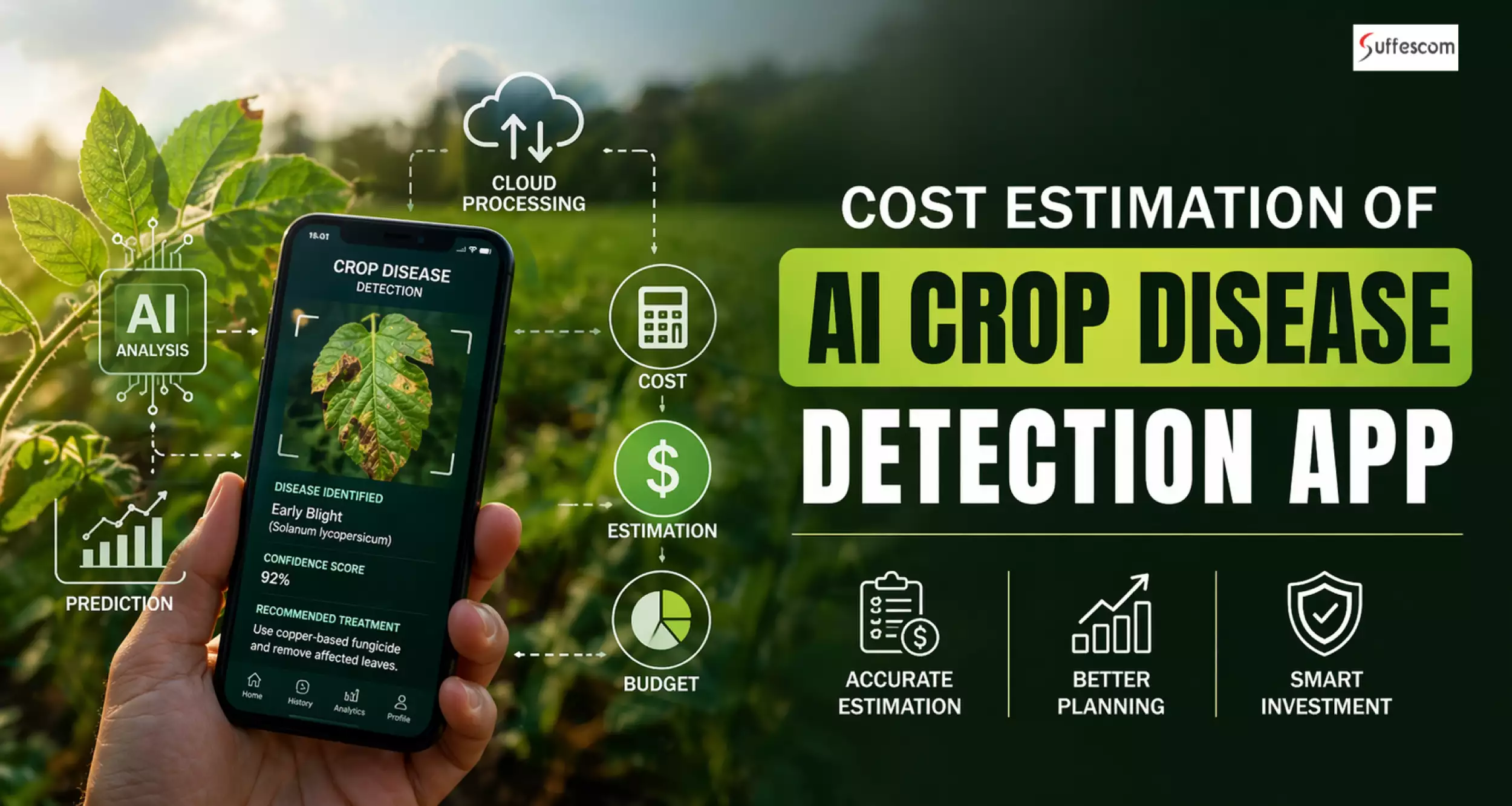
The agriculture industry is rapidly evolving with the adoption of advanced technologies like artificial intelligence and mobile applications. Farmers today need faster, more accurate ways to identify plant diseases and protect crop yield, making digital solutions a critical part of modern farming.
AI-powered crop disease detection apps are transforming how farmers monitor plant health by enabling real-time diagnosis and actionable insights. These apps reduce dependency on manual inspection and help prevent large-scale crop damage through early detection.
For agritech businesses and startups, investing in such a solution is a strategic move. However, understanding the crop disease app development cost is essential before starting. It allows you to plan your budget effectively, prioritize the right features, and choose a development approach that ensures maximum return on investment.
Start Your Agritech Solution
Leverage AI to build smarter, data-driven farming applications. Talk to our experts and begin your journey today.
AI-Based Crop Disease Detection Apps Growth in 2026 and Beyond
The agriculture sector is rapidly shifting toward smart farming, where AI-powered solutions are becoming essential rather than optional.
In 2026, crop disease detection apps are emerging as a key component of precision agriculture, helping farmers minimize losses and maximize productivity through real-time insights.
With increasing smartphone usage in rural areas, better internet connectivity, and growing awareness of digital farming tools, the adoption of AI-driven agriculture apps is accelerating across global markets.
Key 2026 Stats & Future Outlook
- The global AI in agriculture market is expected to surpass $5+ billion by 2030
- Over 60% of farmers are adopting mobile-based crop monitoring solutions
- AI-powered crop disease detection tools are witnessing 25–35% annual growth
- Early disease detection using AI can reduce crop losses by up to 30%
- Precision agriculture technologies can improve farm productivity by 20–25%
What’s Next in AI Agriculture Apps
- AI-driven predictive disease detection before visible symptoms
- Integration with IoT sensors and smart farming equipment
- Real-time crop monitoring using satellite and drone imagery
- Automated recommendations for fertilizers and treatments
This rapid growth highlights why investing in crop disease app solutions is becoming a high-potential opportunity for agritech businesses.
Key Factors Influencing Crop Disease App Development Cost
Several variables directly impact the AI agriculture app development cost. Understanding these will help you plan your budget more accurately.
1. AI Model Complexity
A simple image classification model costs less, while advanced deep learning models (CNNs, Vision Transformers) require more investment in training, testing, and optimization.
2. Dataset Collection & Training
High-quality labeled datasets are essential. Costs increase if you need:
- Custom dataset collection
- Data annotation
- Model retraining
3. Platform Choice
- Android only: Lower cost
- iOS + Android: Higher cost
- Web + Mobile ecosystem: Highest cost
4. UI/UX Design
User-friendly interfaces for farmers (often non-technical users) require thoughtful design, which adds to cost.
5. Third-Party Integrations
APIs for weather data, satellite imagery, or cloud storage increase development expenses.
6. Development Team Location
- India: Cost-effective
- US/Europe: Higher development rates
Feature Breakdown Impacting Crop Disease App Cost Structure
Features play a decisive role in determining the overall crop disease app development cost. The more advanced and intelligent the functionality, the higher the investment required. Below is a structured explanation of how different feature levels impact development.
Core Features
These are the foundation of any crop disease detection app and are necessary for a functional MVP.
- Image upload for disease detection: Allows users to upload plant images for analysis, forming the base of AI interaction.
- AI-based disease identification: Uses machine learning models to detect diseases from images with reasonable accuracy.
- Basic treatment recommendations: Provides simple, rule-based suggestions to help farmers take immediate action.
- User registration & dashboard: Enables user management and stores scan history, improving user experience.
These features keep the crop disease app development cost relatively low and are ideal for initial launches.
Advanced Features
These enhance usability and intelligence, increasing engagement and accuracy.
- Real-time camera detection: Detects diseases instantly using live camera input, improving convenience.
- Multi-language support: Makes the app accessible to farmers across different regions.
- Offline detection capability: Allows usage without the internet by integrating lightweight AI models.
- Disease history tracking: Stores past data to help users monitor crop health over time.
These features moderately increase the crop disease app development cost due to added complexity.
Premium Features
These are enterprise-level capabilities designed for scalability and precision farming.
- IoT sensor integration: Connects with field sensors to collect real-time environmental data.
- Weather-based disease prediction: Uses climate data to forecast potential disease outbreaks.
- AI-driven yield analysis: Provides insights on crop productivity and optimization strategies.
- Expert consultation/chat: Enables farmers to connect with agricultural experts directly.
These significantly raise the crop disease app development cost but deliver high long-term value.
Technology Stack for AI Agriculture App Development Projects
Choosing the right technology stack is essential for building a scalable, high-performance solution while controlling the overall crop disease app development cost. A well-planned stack ensures faster development, easier maintenance, and long-term cost efficiency.
| Component | Technologies | Purpose / Benefits |
| Frontend |
|
|
| Backend |
|
|
| AI/ML Technologies |
|
|
| Cloud & Storage |
|
|
| Database |
|
|
A well-optimized technology stack not only enhances app performance but also significantly reduces the long-term crop disease app development cost by improving scalability, flexibility, and maintenance efficiency.
How Does AI Help with Crop Disease Detection in Farming?
Artificial intelligence is transforming modern agriculture by enabling faster, more accurate, and scalable disease detection, which directly increases the value of crop disease app development.
1. Image Recognition
AI-powered models analyze plant images to detect diseases with high precision, even in early stages.
2. Early Detection
AI identifies subtle patterns before visible symptoms appear, helping prevent large-scale crop damage.
3. Precision Agriculture
It delivers targeted treatment recommendations based on specific diseases rather than generic solutions.
4. Data-Driven Insights
AI analyzes large datasets across farms to identify trends and predict possible outbreaks.
5. Reduced Dependency on Experts
Farmers can instantly diagnose crop issues without relying on agricultural specialists.
6. Scalability
AI systems can support thousands of users simultaneously, making solutions accessible at scale.
Addon Costs in AI-Based Crop Disease App Development Process
When estimating the cost of developing an AI-based crop disease detection app, many organizations focus primarily on initial development and overlook several ongoing and indirect expenses. These hidden costs can significantly affect long-term return on investment if not accounted for early.
1. Data Acquisition Costs
Data acquisition is often one of the most underestimated areas. High-quality, labelled agricultural datasets, especially region-specific crop disease images, can be expensive to collect, annotate, and maintain. Without robust data, model accuracy suffers.
2. Model Maintenance
Model maintenance is another continuous expense. AI models degrade over time due to changing environmental conditions, new disease patterns, or crop variations. Regular retraining, validation, and performance monitoring are essential to keep predictions reliable.
3. Cloud Infrastructure
Cloud infrastructure costs also accumulate quickly. Hosting, storage, GPU processing, and API calls, especially at scale, can become substantial recurring charges as user adoption grows.
4. App Maintenance
Beyond AI, general app maintenance must be considered. This includes fixing bugs, updating UI/UX, and rolling out new features to remain competitive.
5. Compliance & Security
Compliance and security costs are critical, particularly when handling farmer data or integrating with government systems. Adhering to data protection regulations requires both technical safeguards and legal oversight.
6. Scaling Costs
Finally, scaling costs can surge as the user base expands. Supporting more users demands stronger infrastructure, better load balancing, and potentially global deployment capabilities.
Factoring these into your AI-based crop disease detection app development cost prevents budget overruns.
Launch Your AI Agriculture MVP
Validate your idea with minimal investment and faster time to market.Connect with our development team to get started.
Cost Comparison: MVP vs Full-Scale AI Agriculture App Build
Understanding MVP vs full-scale development helps in strategic planning.
| Aspect | MVP Development | Full-Scale AI Agriculture App |
| Estimated Cost | $25,000 – $50,000 | $80,000 – $150,000+ |
| Features | Basic AI disease detection, limited UI | Advanced AI models, analytics, and integrations |
| Purpose | Market validation, early user feedback | Commercial deployment, scalability |
| Development Time | Shorter (faster launch) | Longer (more complex build) |
| Risk Level | Lower (test before heavy investment) | Higher (larger upfront investment) |
| Scalability | Limited | High (built for growth) |
| Maintenance Needs | Minimal initially | Ongoing updates and optimization |
Key Insight:
Starting with an MVP allows businesses to validate demand, gather user feedback, and refine the product before committing to a full-scale investment. This phased approach helps reduce financial risk and optimize overall crop disease app development costs.
Tips to Optimize AI Agriculture App Development Cost Efficiently
Reducing costs without compromising quality is possible with the right strategy.
1. Start with an MVP
Focus on essential features like disease detection, enabling faster launch, early feedback collection, and reduced initial development investment risk.
2. Use Pre-trained Models
Leverage existing trained AI models to save time, reduce data requirements, and improve accuracy without extensive custom model development efforts.
3. Choose Cross-Platform Development
Use frameworks like Flutter or React Native to build one app for multiple platforms efficiently.
4. Outsource to Experienced Teams
Partner with skilled developers in cost-effective regions to reduce expenses while maintaining quality, faster delivery, and access to specialized expertise.
5. Use Cloud-Based AI Services
Adopt cloud platforms for AI processing, storage, and scalability, avoiding high upfront infrastructure costs and paying only for actual usage.
6. Prioritize Features
Identify and develop only high-impact features initially, avoiding unnecessary complexity, reducing costs, and ensuring a focused, user-centric application experience.
7. Agile Development Approach
Follow iterative development cycles with continuous feedback, enabling quick improvements, reduced rework, better resource utilization, and overall cost efficiency.
Conclusion
Developing an AI-based crop disease detection app requires careful planning, not just in terms of features but also overall cost strategy. From understanding key cost drivers like AI complexity, datasets, and infrastructure to identifying hidden expenses such as maintenance and scaling, every factor plays a critical role in determining the final investment. Starting with an MVP is a practical approach to validate market demand while minimizing financial risk. As highlighted, optimizing development through pre-trained models, cross-platform frameworks, and agile practices can significantly improve cost efficiency. Ultimately, a well-balanced approach ensures long-term scalability, better ROI, and sustainable growth in the evolving agritech landscape.
Build AI Crop Disease App
Launch a scalable crop disease detection solution with expert support.Get a free consultation and cost estimate today.
FAQs
1. What is an AI-based crop disease detection app?
An AI-based crop disease detection app is a mobile or web solution that uses machine learning and image recognition to identify plant diseases from photos and provide treatment recommendations to farmers in real time.
2. What factors influence the cost of developing a crop disease detection app?
The cost depends on several factors such as AI model complexity, dataset quality, app features (basic vs advanced), platform choice (Android, iOS, or both), third-party integrations, and development team location.
3. How long does it take to build an AI crop disease detection app?
An MVP (Minimum Viable Product) can take around 2–4 months, while a full-scale AI-powered app with advanced features like IoT integration and predictive analytics may take 6–12 months depending on complexity.
4. Why should businesses invest in Plant Care App Development?
Investing in Plant Care App Development helps agritech businesses provide scalable, data-driven solutions for farmers, improve crop yield, reduce losses, and tap into the rapidly growing AI in agriculture market.
5. What are the essential features of a crop disease detection app?
Core features include image upload, AI-based disease detection, basic treatment suggestions, and a user dashboard. Advanced apps may also include real-time camera detection, offline functionality, and disease history tracking.
6. How Does AI Help with Crop Disease Detection?
AI helps by analyzing plant images for early disease identification, detecting patterns before visible symptoms appear, providing precise treatment recommendations, and enabling farmers to make faster, data-driven decisions without relying heavily on experts.