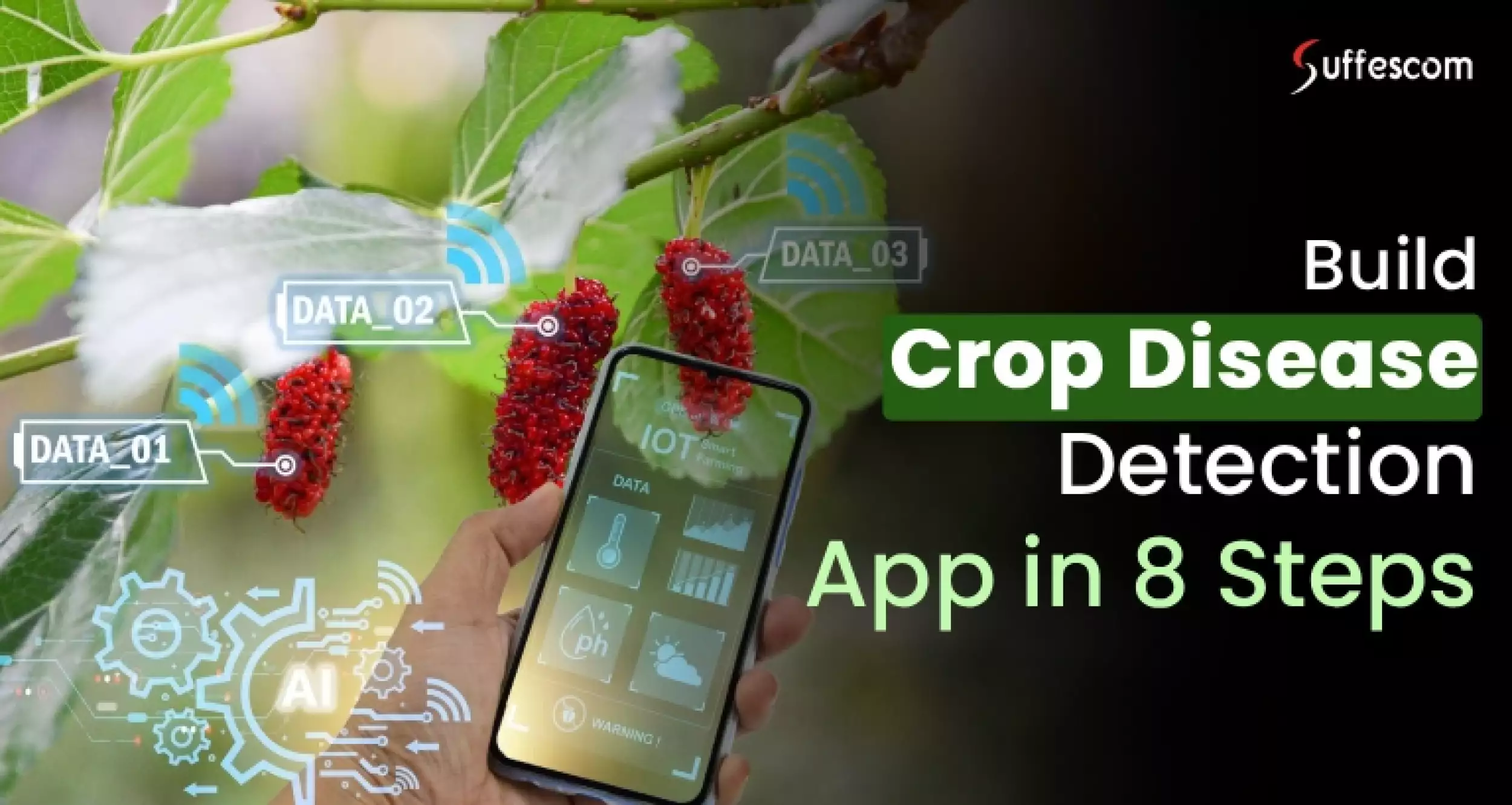
Crop diseases and nutrient deficiencies can silently damage yields before farmers even realize there's a problem. Earlier, identifying pests, spotting infections, as well as understanding soil deficiencies required expert knowledge, manual inspection, along with valuable time that often led to delayed action & crop loss. But with an AI-powered crop disease detection app, farmers can now diagnose issues instantly and take timely action.
Crop Disease Detection Apps deliver:
- Seamless crop monitoring anytime, anywhere
- Accurate detection of diseases, pests & nutrient deficiencies
- Faster decision-making to protect yield and quality
According to industry insights, the global smart agriculture market was valued at USD 25.36 billion in 2024 & is expected to reach USD 83.72 billion by 2033, growing at a CAGR of 14.6% from 2025 to 2033.
These trends compel farmers to adopt AI-driven precision farming solutions. So, waiting for what?
Say goodbye to guesswork, as well as manual checks. Build an AI crop disease detection app to empower smarter farming.
Stay tuned with Suffescom to develop an intelligent solution that transforms crop care!
Launch an AI-enriched Crop Disease Detection App Today with Expert Guidance!
What do You Understand by Crop Disease Detection App Development?
We built a crop disease detection app that allows us to detect all types of farming-related issues, including diseases, pests & nutritional deficiencies. How it works:
- Farmers click the picture of an affected crop (like a leaf)
- Uploads it into the app
- Now, the app uses AI technology to analyze the image
- Detect if the plant is healthy or infected
- Shows the disease name with basic guidance on what to do next
This is how the app helps identify different crop problems and helps farmers prevent crop loss & improve overall yield.
Traditional Plant Disease Identification System v/s Suffescom's Crop Disease Detection App development
| Feature | Traditional Plant Disease Detection App | AI-Based Crop Disease Detection App |
| Speed | Slow | Instant |
| Accuracy | Variable | High |
| Cost | High (experts) | Low |
Build Revenue-Ready Crop Disease Detection Solution Today!
Build an AI-Powered Crop Disease Detection App – Just in 8 Steps
When a client approaches us with an idea for an AI-powered crop disease detection app, our goal is not just to build an app, but to create a scalable, accurate, as well as market-ready agri-tech solution. We use a simple yet effective development approach.
Here's exactly how we execute the process, step by step:
Step 1: Requirement Analysis & Business Understanding
Once you share your idea, our first focus is to deeply understand your vision. Our engineers do not jump into development immediately; they first analyze:
- Target users (farmers, agri-businesses, consultants)
- Crop types and geographic focus
- Core problem (disease detection, prevention, advisory)
- Expected outcomes (accuracy, speed, scalability)
At this stage, our main motive is to align your business goals with the right technical approach. This makes sure we develop what you actually need, not just what sounds good.
Step 2: Solution Architecture & AI Strategy Planning
Once we have a complete understanding of your business requirements, our team begins the development process by creating a clear technical roadmap. Here, we define:
- Whether to use pre-trained AI models or build a custom model
- Image processing approach (computer vision, deep learning)
- Backend architecture (cloud-based, scalable APIs)
- Integration points (mobile app, web dashboard)
This is how we create a blueprint for your entire product. Our main motive is to build a more powerful & an enterprise-ready solution, as strong architecture = faster development + long-term scalability.
Step 3: Dataset Strategy & AI Model Preparation
Most projects fail when they do not profoundly understand that AI accuracy depends on data. Thus, our experts:
- Identify relevant crop disease datasets
- Clean & structure the data
- Train or fine-tune AI models
- Validate model performance
It is important to understand that better data = better predictions = better product value. Thus, if required, we also help in custom dataset creation for higher precision.
Step 4: UI/UX Design Focused on End Users
At this stage, our engineers start designing the app by keeping real users in mind, especially farmers who prefer simplicity. Thus, while designing the user interface, we ensure:
- Minimal & intuitive interface
- Easy image upload (camera-first approach)
- Clear result display with actionable insights
- Multi-language support (if required)
Our team designs a simple yet effective interface that even a layman or non-technical user can operate easily.
Step 5: Backend Development & Data Structuring
This is the brain of every application that helps the system make decisions. Our team build the core system that powers your app. Our experts start developing:
- Secure and scalable backend infrastructure
- Database for users, images, disease records & results
- APIs to connect the frontend with AI models
- Cloud storage for image handling
We structure everything in a way that supports high system performance, along with future scalability.
Step 6: AI Integration and Core Functionality Development
At this stage, we integrate a fully trained AI model into the crop disease detection app. This works in the following way:
- User uploads a crop image
- The image is sent to the AI engine
- Model processes & detects disease
- Results are sent back with a confidence score
At this point, we make sure the system responds quickly as well as accurately to inputs, delivering a seamless user experience. Once this is fulfilled, your product becomes truly AI-powered.
Step 7: Advanced Features & Real-World Enhancements
Beyond core functionality, we focus on features that add real business value. Here, our experts integrate:
- Treatment recommendations & preventive measures
- Weather-based crop insights
- Notification systems (alerts, updates)
- Multi-language support for wider reach
- Admin dashboard for monitoring as well as analytics
These functionalities make your app more practical, usable, as well as competitive.
Step 8: Testing, Deployment & Continuous Scaling
Before launching a crop disease detection app, our team of testers conducts thorough testing to ensure the system's reliability. To do so, we test:
- AI prediction accuracy
- App performance under different conditions
- User flows & usability
- Device and network compatibility
Once the system is tested, it is sent for deployment, where we evaluate whether:
- Launch on web & mobile platforms
- Cloud deployment for scalability
- Domain and server setup
Our duties are not over even after the deployment. We offer post-launch assistance to keep your system up to date. Over time, our engineers:
- Improve AI accuracy with real-world data
- Add new crops & disease categories
- Introduce predictive analytics
- Continuous performance optimization
Overall, we do not just believe in delivering; we help you grow & evolve your product.
The Science Behind Detecting Hidden Plant Health Problems
We integrate smart AI-driven technologies that work behind the house plant identification app to analyze plant images, patterns, as well as environmental data. Explore the core technologies behind crop problem detection:
- Artificial Intelligence (AI): Powers the app's overall intelligence, helping it learn from plant data, plus improving accuracy over time.
- Machine Learning (ML): AI machine learning crop disease detection enables the system to identify patterns in plant diseases, pests, as well as nutrient deficiencies based on trained datasets.
- Computer Vision: Allows the app to see and analyze plant images. Aids in detecting spots, discoloration, leaf damage & other visible symptoms.
- Deep Learning (CNN Models): Convolutional Neural Networks (CNNs) are particularly effective for image classification and disease detection, achieving high accuracy.
- Image Recognition: Enhances & preprocesses images (e.g., resizing, filtering) to improve detection quality.
- Cloud Computing: Stores large datasets while also processing complex models quickly. Permits real-time analysis.
- IoT (Internet of Things): Collects real-time environmental data like soil moisture, temperature, as well as humidity to support better diagnosis.
- Big Data Analytics: Analyzes large volumes of agricultural data to identify trends, along with improving prediction accuracy.
- GPS & Geolocation: Helps track field-specific issues, plus provides location-based recommendations.
- Mobile App Technology (Android/iOS): Allows farmers to capture images and receive instant results directly on their smartphones.
Technology Stack Behind AI-Powered Agriculture Disease Detection Systems
Explore the following to understand the cutting-edge technologies we utilize to build custom AI agriculture app:
| Technology Layer | Tools / Technologies | Purpose (Simple Explanation) |
| Frontend (User Interface) |
| Create a simple & user-friendly interface where users can upload images, and view results |
| Backend (Server Side) |
| To handle user requests, process data, and connect the frontend with AI models |
| AI / Machine Learning |
| To train models that can identify crop diseases from images |
| Image Processing |
| To clean, resize & prepare images before sending them to AI models |
| Deep Learning Models |
| To analyze leaf images and detect disease patterns accurately |
| Database |
| To store user data, uploaded images, and detection results |
| Cloud Services |
| To host the app, store data, and scale the system as users grow |
| Storage Solutions |
| To securely store large volumes of crop images |
| API Integration |
| To connect frontend, backend & AI systems smoothly |
| Authentication & Security |
| To secure user login and protect data |
| Notifications |
| To send alerts, updates, as well as important notifications to users |
| Maps & Location (Optional) |
| To track farm location or provide region-based insights |
| DevOps & Deployment |
| To deploy the app efficiently & manage updates smoothly |
| Monitoring & Analytics |
| To track user behavior and improve app performance |
Discuss Your AI-based Crop Disease Detection Development Idea with Our Experts Today!
How does AI Help with Crop Disease Detection in the Plant Care App?
We integrate AI into a plant disease identification platform to address the real limitations of manual farming practices & large-scale monitoring challenges. Explore how crop disease detection using AI helps to resolve plant issues:
Early Detection (Before Visible Damage)
Humans usually detect disease after symptoms become obvious, but an AI-oriented plant ailment finder platform comes with features that allow it to identify subtle patterns in leaves as well as crops that humans often miss. This results in:
- Early stage disease detections
- Prevents spread across the field
- Decrease crop loss significantly
Scalability Across Large Farms
Manual inspection seems impossible, especially at scale. But with the help of AI, monitoring thousands of acres at once becomes possible. It supports:
- Drones
- Satellite imagery
- IoT sensors
Instant Diagnosis (Real-Time Decisions)
Traditional diagnosis is not only slow, but also often delayed. However, an AI-enriched crop disease-detection system delivers results within seconds. That means:
- No waiting for experts or lab tests
- Faster treatment decisions
- Reduces time-to-action
High Accuracy & Consistency
Farmers and field agents may misdiagnose; AI standardizes diagnosis. AI (especially computer vision models) is trained on thousands/millions of crop images. This helps to:
- Identifies exact disease type (fungal, bacterial, nutrient deficiency)
- Eliminates human guesswork
- Confers consistent results every time
Cost Reduction
An AI lowers operational costs for farmers as well as agribusinesses by reducing dependency on:
- Field experts
- Lab testing
- Repeated inspections
Accessibility for Farmers (Even in Remote Areas)
Farmers do not always have access to agronomists or experts. AI tools are often available via:
- Mobile apps
- Offline-compatible systems
Precision Treatment Recommendations
An AI machine-learning crop disease detection system helps to avoid overuse of chemicals & improves yield. It does not just detect, it also suggests:
- Correct pesticide or fungicide
- Location-specific treatment
- Proper dosage
Data-Driven Insights & Prediction
Moves farming from reactive → predictive. AI systems collect & analyze large datasets:
- Predict disease outbreaks
- Identify seasonal patterns
- Help in yield forecasting
Why Invest in Our Crop Disease Detection App Development Solutions?
Explore the following to understand what makes our crop disease detection app solutions unique from others:
- Fast & Accurate Treatment Suggestions: The platform not only detects diseases but also provides clear, as well as practical treatment recommendations for infections & nutrient deficiencies.
- Instant Crop Analysis: Farmers can simply upload a crop image & receive a quick diagnosis. Our system makes sure to identify crop issues without delay.
- Smart Fertilizer Calculation: An in-app calculator helps users determine the exact fertilizer requirements based on land size & crop type.
- Real-Time Weather Updates: Accurate weather information helps farmers prepare in advance & decrease the risk of crop damage.
- Expert Agricultural Support: AI-based crop disease detection platform offers access to experienced professionals who provide trusted advice, along with recommendations when needed.
- Improved Crop Yield: With the right insights, along with guided farming practices, allow users to make better decisions that help increase overall productivity.
- Actionable Farming Tips: We provide immediate, easy-to-follow guidance along with preventive measures to protect crops from potential risks.
- Activity Planning Made Easy: Based on weather & crop conditions, users can efficiently plan tasks like, sowing, spraying, as well as harvesting.
- Farmer Community Access: Provides a wide network of farmers to share experiences, ask questions, plus find reliable solutions.
- Comprehensive Crop Guidance: From crop selection to different growth stages, the plant care app provides detailed guidance, including best practices, pest control, and nutrient management.
Integrated Advanced Functionalities That Set Our Crop Disease Detection App Development Solutions Apart
Predictive Disease Analytics
Forecasts potential disease risks based on historical patterns, seasonal trends, as well as environmental conditions.
- Early risk identification
- Seasonal outbreak predictions
- house plant identification
- Climate-based disease alerts
Personalized Crop Advisory Engine
Delivers tailored recommendations based on crop type, soil profile, along with regional farming conditions.
- Customized crop-specific guidance
- Soil-based recommendation accuracy
- Region-aware farming insights
Satellite & Drone Integration
Our plant crop disease detection app solutions integrate with aerial imagery for large-scale field monitoring, along with detection beyond manual image capture.
- Wide-area crop health visibility
- Early spotting across large fields
- High-precision aerial crop insights
Farm Mapping & Field Segmentation
Allows users to digitally map fields, as well as monitor crop health by zone.
- Boundary mapping with GPS
- Segment-based issue identification
- Area-specific action planning
Community & Expert Connect Module
Connects farmers with agronomists or peer communities for discussion & expert consultation.
- Farmer-to-farmer knowledge sharing
- Real-time discussion forums
- Regional farming community groups
Input Usage Tracking
Tracks fertilizers, pesticides, along with treatments applied to crops for better farm management.
- Tracks input application history
- Monitors usage frequency patterns
- Records the quantity of inputs used
- Maintains treatment application logs
Weather-Based Smart Recommendations
AI machine learning crop disease detection services adapt suggestions dynamically based on upcoming weather forecasts and climate conditions.
- Optimizes irrigation planning
- Reduces weather-related risks
- Suggests preventive actions (about bad weather occurrences)
Marketplace Integration
Enables users to purchase recommended agricultural inputs (from third-party vendors) directly through the plant care app.
- Verified supplier access
- Seamless checkout experience
- Real-time product availability
Yield Prediction Module
Estimates expected crop yield based on current crop health, along with historical farm data.
- Improves harvest planning accuracy
- Supports better resource allocation
- Optimizes farm productivity insights
AI Chatbot Assistance
AI-enriched crop disease detection app provides instant query resolution related to crop health, farming practices & app usage.
- Instant crop-related query responses
- Context-aware farming guidance
- Voice & text interaction support
- 24/7 automated assistance availability
Core Capabilities of the AI Plant Disease Detection App
Multi-Crop Support System
AI-enriched crop disease detection app solutions support detection across a wide range of crops (fruits, vegetables, grains, etc.) within a single platform.
- No need to switch between different tools or apps
- No dependency on crop-specific expertise
- No limitations to a single crop type for monitoring
Offline Mode Functionality
Allows users to capture & store images without internet access, plus sync results once connectivity is restored.
- Uninterrupted crop monitoring (Remote & Poor network areas)
- Prevents data loss (save images & observations for later processing)
- Promotes Continuous fieldwork ( no waits for internet availability)
Real-Time Alerts & Notifications
Sends instant alerts about detected issues, weather risks, or disease outbreaks in nearby areas.
- Enables quick action to stop issues from spreading
- Minimizes crop damage with timely alerts
- Supports faster decisions with real-time updates
Historical Scan Records
Maintains a structured history of previously scanned crops, diagnoses & actions taken for future reference.
- Tracks crop health over time
- Identifies recurring issues quickly
- Improves decisions using past data
Multi-Language Interface
Provides localized language support to make sure usability for farmers across different regions.
- Easy understanding of the system
- Reduces language barriers
- Improves user accessibility
User-Friendly Dashboard
Displays crop health summaries, recent scans, along with actionable insights in a simple, visual format.
- Quick crop health overview
- Easy decision visualization
- Faster daily monitoring
Voice Input & Assistance
Enables farmers to interact with the app using voice commands for easier accessibility.
- Faster data input
- Hands-free app navigation
- Accessible for low literacy users
Monetization Strategies for Crop Disease Detection Platforms (B2B & B2C)
The AI machine learning crop disease detection app development solutions help businesses drive revenue by offering the following revenue streams:
| Revenue Model | B2B Revenue Generation (Who Pays) | B2C Revenue Generation (Who Pays) | How It Helps Client Generate Revenue |
| Subscription-based (SaaS) |
|
|
|
| Freemium → Paid Upgrade |
|
|
|
| Advisory & Expert Services |
|
|
|
| Lead Generation / Commission |
|
|
|
| Marketplace / E-commerce |
|
|
|
| Data Monetization |
|
|
|
| API / White-label Licensing |
|
|
|
| Insurance Partnerships |
|
|
|
| Government / CSR Contracts |
|
|
|
| Hardware Integration (IoT/Drones) |
|
|
|
| Advertising / Sponsored Content |
|
|
|
Types of Crop Monitoring App Solutions That Suits for Every Business’ Budget, Requirements and Ideas
We offer end-to-end solutions to help you create a smart, reliable plant disease-detection app tailored to your business needs. From idea validation to full-scale deployment, we support every stage of the development process.
- MVP App: It quickly turns your idea into a working app so you can launch fast. Perfect for startups that want quick results, along with full control over their code.
- No-Code or Low-Code: Want to launch without heavy coding? Dedicated Builders experts use builders that make the process more easy with drag-and-drop facilities to build apps for every business.
- Custom App Development: For larger businesses, we build fully customized apps from scratch, tailored to your workflows, rules, as well as user needs.
- White-Label Solutions: Launch your own branded plant ailment-detection app quickly with ready-made AI solution. Great for businesses looking to enter the market without starting from zero.
- Build Like Popular Apps: We create apps similar to popular platforms like Plantix, Agrio, or PlantIn, customized with your branding & features.
Why Partner with Suffescom?
The Suffescom, as the leading mobile development company, is known for building future-ready solutions with AI-powered features. Explore why our clients & partners love us:
- 13+ Years of Experience: We have served the IT industry for 13 years; thus, we know how to create scalable, robust solutions to meet diverse businesses' needs.
- Faster Time-to-Market = Faster ROI: Our engineers leverage ready-to-use AI components & tested development frameworks to shorten the deployment cycle. This helps you launch in just a few weeks.
- Different Development Options: We offer custom-built, ready-made (white-label), as well as no-code options, depending on your budget, needs & timeline.
- Designed to Impress Your End Users: Intuitive interfaces, multilingual support & seamless mobile experiences make sure high adoption among farmers as well as agronomists.
- Ongoing Support After Launch: To keep your application running smoothly & securely over time, our engineers provide continuous support to maintain the system scalability.
- Built-In Compliance & Security: We keep all the compliance and security standards in mind while building plant disease detection platforms to safeguard your operations.
Top Plant Disease Detection App Development Solutions: Clone Your Way
Explore the following popular plant ailment finder apps that our engineers can clone for you with personalized features:
| Apps | Platform Accessibility | Launched On | Download Users | Stores Ratings | Primary Use Case |
| Plantix | Android, iOS | 2015 | 10M+ | 4.5★ | AI-based crop disease detection + treatment advice for farmers |
| Agrio | Android, iOS, Web | 2020 | 1M+ | 4.6★ | AI pest & disease detection + farm monitoring + alerts |
| PlantIn | Android, iOS | 2019 | 10M+ | 4.3★ | Plant identification + disease detection for home or garden users |
| iNaturalist | Android, iOS, Web | 2008 | 5M+ | 4.5★ | Species, houseplant identification & biodiversity tracking (not crop-focused) |
| Leaf Doctor | Android (limited), Desktop tools | 2013 | 100K+ | 3.8★ | Leaf disease severity measurement (research-oriented) |
Request a Free Demo for Crop Disease Detection AI-Powered App Solution!
Frequently Asked Questions
What is an AI-based crop disease detection app?
An AI crop disease detection app uses machine learning & computer vision to analyze plant images, plus identify diseases in real time. It classifies diseases (fungal, bacterial, viral) and provides actionable insights, such as treatment recommendations. This helps agribusinesses to improve crop yield while reducing losses.
What is the typical accuracy of AI crop disease detection systems?
Modern AI models achieve 85 to 95% accuracy, depending on dataset quality and environmental conditions.
What are the business benefits of developing a crop disease detection app?
The business benefits of developing a crop disease detection app includes:
- Early disease detection (5–14 days faster)
- Reduced crop losses (up to 15–30%)
- Increased yield and ROI
- Data-driven farming decisions
- Scalable agritech solutions
How much does it cost to develop a crop disease detection app?
The development cost of the crop disease detection platform may vary based on project scope, complexity levels, along with integrations, as well as advanced features. However, a basic MVP app may cost from $5,000 to $15,000, a middle-level system may cost $ 15,000 to $25,000+, and an advanced AI platform may cost between $25,000–$40,000+.
How long does it take to build an AI crop disease detection app?
Timeline depends on features, AI training & level of integrations. However, a typical development timeline may take:
- MVP: 4 to 6 weeks
- Middle-level app: 3 to 6+ months
- Full-scale platform: 12 to 16+ months
Can crop disease detection apps work offline?
Absolutely! We design plant disease identification solutions with offline inference capabilities using on-device AI models. This makes them ideal for rural or low-connectivity regions.
How scalable are AI crop disease detection platforms?
We build scalable AI crop disease detection platforms that leverage cloud infrastructure & can support multiple crops, geographies, along with millions of users simultaneously.
What is the future of AI in crop disease detection?
AI will play a critical role in achieving sustainable as well as precision agriculture at scale. Thus, the future may consist of:
- Predictive analytics for disease outbreaks
- Integration with satellite imagery
- AI-powered autonomous farming
- Hyper-personalized crop advisory systems
How is AI used with drones or IoT in agriculture?
AI integrates with drones & sensors to monitor large farms, detect disease spread, plus provide real-time field analytics and alerts.
What are the challenges in developing crop disease detection apps?
The below are the major challenges that arise during the development process:
- Limited labelled datasets
- Real-world environmental variability
- Model accuracy in field conditions
- Integration with IoT & external systems