
Key takeaways:
- Prediction markets are becoming a billion-dollar Web3 sector driven by platforms like Polymarket and Kalshi.
- Building a Polymarket-like platform costs $10K–$80K+ depending on features, scalability, and compliance needs.
- Blockchain choice, oracle integration, and liquidity model are the biggest cost-defining factors.
- Custom builds, white-label solutions, and clone scripts offer different paths based on budget and goals.
- Smart contracts, security audits, and compliance are essential for creating a reliable prediction market platform.
- A strategic development approach helps reduce costs while building a scalable and future-ready platform.
Want similar results? → Get a Free Quote
Prediction markets have evolved rapidly over the past few years. What started as a niche experiment in 2020 and has now become a high-growth financial segment. In 2025 alone, the industry crossed $40–$60+ billion in total trading volume, with platforms like Polymarket and Kalshi leading the expansion.
According to TRMlabs, by 2026, monthly trading activity will have scaled significantly, with volumes exceeding $20 billion per month and user participation growing across global markets. This surge has attracted institutional attention and positioned prediction markets as a serious data-driven financial ecosystem rather than a speculative niche.
If you are evaluating the cost to build a prediction market platform, this guide provides a detailed, data-backed breakdown of every major cost component, from smart contract development to post-launch operations. It is based on real-world project benchmarks and current market rates.
Understanding Polymarket Before Estimating Polymarket Clone Development Cost
Before discussing the Polymarket clone development cost, you need to understand exactly what you are cloning. Polymarket is not simply a betting website. It is a sophisticated decentralized prediction market infrastructure built on Polygon (an Ethereum Layer-2 blockchain), using USDC as its settlement currency, with a Central Limit Order Book (CLOB) liquidity model and a UMA Protocol oracle for trustless event resolution.
How Polymarket Works: The Core Mechanics
Users deposit USDC, create or browse prediction markets, and trade binary outcome shares (YES/NO). Each share is priced between $0 and $1, where the price represents the market-implied probability. When the event resolves, winning shares pay $1.00 and losing shares pay $0.00. The platform earns a spread on each trade.
How a Prediction Market Platform Actually Process Trades?
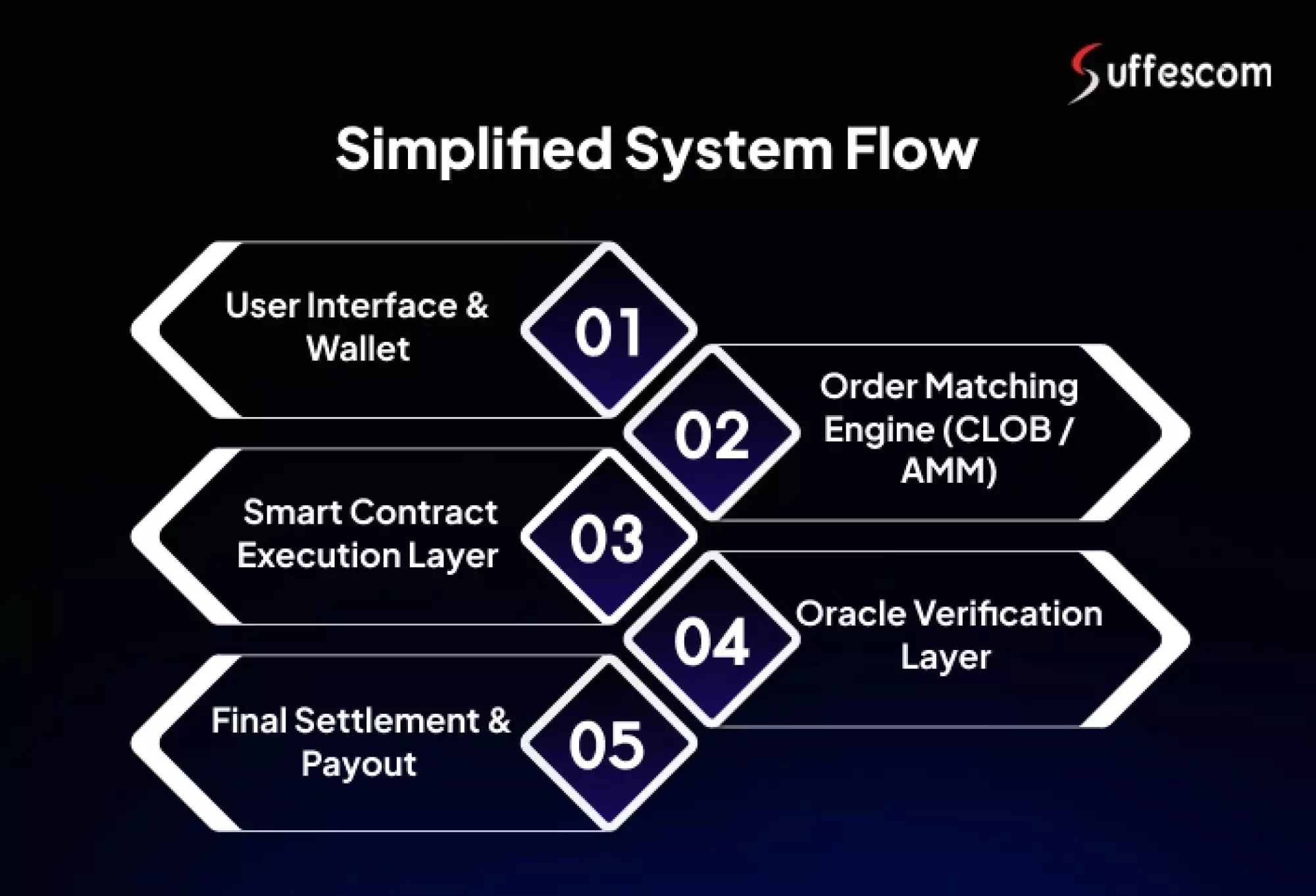
Before estimating the cost to create a prediction market platform like Polymarket, it’s important to understand how data and transactions actually flow through the system.
A prediction market is not just UI + smart contracts, it is a multi-layer execution pipeline involving trading logic, liquidity systems, and real-world data validation.
Cost to Build a Prediction Market Like Polymarket — The Complete Breakdown
A well-structured cost strategy not only minimizes development risks but also ensures architectural scalability, security compliance, and sustainable platform growth.
Prediction Market Development Cost by Platform Stage
| Platform Tier | Estimated Cost | Timeline | Best For | Scalability |
| MVP / Proof of Concept | $10,000 – $25,000 | 2 – 4 months | Validation & fundraising | Low (up to 1K users) |
| Growth-Stage Platform | $25,000 – $50,000 | 4 – 7 months | Early market traction | Medium (up to 10K users) |
| Enterprise / Institutional | $50,000 – $80,000+ | 10 – 14 months | Regulated, institutional use | Enterprise (1M+ users) |
Development Approach: Custom Build vs White Label vs Polymarket Clone Script
Before diving into granular component costs, it is critical to choose your development approach. Each path carries fundamentally different cost, time, and risk profiles.
Comparison of Development Approaches
| Factor | Custom Build | White Label Solution | Polymarket Clone Script |
| Cost | $50,000 – $80,000+ | $10,000 – $25,000 (setup) | $10,000 – $25,000 |
| Timeline | 6 – 14 months | 2 – 6 weeks to launch | 1 – 4 weeks to deploy |
| Customization | Full — unlimited | Moderate | Limited (template-based) |
| Ownership | 100% yours | Licensed (not owned) | Script license only |
| Security Risk | Low (audited from scratch) | Medium (vendor-dependent) | High (often unaudited code) |
| SEO & Branding | Full control | Limited by vendor | Generic branding |
| Best For | Serious market entrants | Testing product-market fit quickly | Demo / proof of concept only |
Three Approaches to Polymarket Clone Development: Which One Fits Your Goals?
There are three different approaches to building a prediction market platform, and each one comes with its own cost, timeline, and level of control.
Approach 1 — Clone Script ($5,000 – $20,000)
A Polymarket clone is pre-built software replicating core platform features: user authentication, order books, trade execution, wallet integration, and an admin panel. You start with functioning code and customize it for your needs rather than building from scratch.
- Best for: Proof-of-concept, rapid MVP, testing a niche category of markets
- Time to launch: 2 – 4 weeks
- Key limitation: Shared codebase origin, limited IP ownership, tech debt accumulates quickly at scale
- Security risk: Clone scripts require an independent third-party audit before mainnet deployment — this adds $10,000–$30,000 on top
Approach 2 — White-Label Platform ($2,000 – $5,000/month)
White-label solutions offer branded prediction market infrastructure under a monthly SaaS model. You get to market in under 14 days with an operational platform while preserving brand identity. This is the fastest path to a real launch, not a test.
- Best for: Market validation with real users before committing to a custom build
- Time to launch: 1 – 3 weeks
- Key consideration: Ongoing SaaS cost compounds over time; evaluate build vs buy at the 12-month mark
Approach 3 — Custom Build ($25,000 – $80,000+)
Custom development — whether a mid-tier startup build or a full institutional-grade platform, gives you complete control over architecture, smart contract logic, liquidity design, and compliance framework. This is what you need if you are building a prediction market development company, product, or positioning for institutional volume.
- Mid-tier custom ($25,000 – $50,000): Full control, 3 – 6 month timeline, suitable for funded startups
- Enterprise custom ($50,000-$80,000+): CFTC compliance, institutional data feeds, AI monitoring, 6 – 12 months
- A legal opinion specific to your architecture costs $2,000 – $4,000 and should happen before you write a single line of production code
Three Approaches to Polymarket Clone Development
| Approach | Cost | Time to Launch |
| Clone Script | $5,000 – $20,000 | 2 – 4 weeks |
| White-Label Platform | $2,000 – $5,000/month | 1 – 3 weeks |
| Custom Build | $25,000 – $80,000+ | 3 – 12 months |
Prediction Market Platform Development Cost: Feature-by-Feature Breakdown
The following table breaks down development cost by functional module for a custom build: This is the most actionable cost data for technical founders and CTOs evaluating how to budget a Polymarket clone development project.
Development Cost Breakdown by Module
| Development Module | What It Covers | Estimated Cost |
| Smart Contract Layer | Binary markets, CTF token logic, settlement, escrow | $8,000 – $20,000 |
| Security Audit (3rd Party) | Full audit, penetration testing | $10,000 – $30,000 |
| Oracle Integration | UMA Optimistic Oracle, Chainlink, Pyth network | $5,000 – $12,000 |
| Frontend UI/UX | Market dashboard, portfolio tracker, onboarding | $10,000 – $25,000 |
| Backend & API Layer | CLOB engine, REST/WebSocket APIs, database architecture | $8,000 – $20,000 |
| Wallet & Payment Gateway | MetaMask, WalletConnect, USDC on/off-ramp | $4,000 – $10,000 |
| Admin Panel & CMS | Market creation, dispute management, analytics | $5,000 – $12,000 |
| Liquidity Module | AMM pools, LP incentives, market-maker tools | $6,000 – $15,000 |
| Compliance & KYC/AML | Geo-restriction, identity verification, regulatory support | $5,000 – $20,000 |
| QA & Testing | Unit, integration, stress, and simulation testing | $4,000 – $10,000 |
Enter a $50B+ Market with the Right Strategy
Launch a scalable platform and create a prediction market platform like Polymarket with proven architecture and optimized cost.
Blockchain Selection: How Your Chain Choice Locks In 40–60% of Your Budget
Your blockchain decision is one of the two biggest cost drivers in prediction market platform development, the other being your liquidity architecture. The following comparison covers the leading options for a 2026 build.
Blockchain Comparison for Prediction Market Development
| Blockchain | Gas Fees | TPS | EVM-compatible | Best For | 2026 Status |
| Polygon (MATIC) | ~$0.001 | 7,000+ | Yes | Budget MVP, proven path | Polymarket migrating away |
| Base (Coinbase L2) | ~$0.0005 | 8,000+ | Yes | US-friendly, institutional | Rapidly growing in 2026 |
| Arbitrum One | ~$0.001 | 40,000+ | Yes | DeFi-heavy platforms | Strong developer ecosystem |
| Ethereum Mainnet | $2 – $15+ | ~15 | Yes | Settlement layer only | Too costly for frequent trading |
| POLY (Polymarket L2) | TBD | TBD | Yes | Polymarket ecosystem | In development, expected 2026 launch |
| Solana | ~$0.00025 | 65,000+ | No | High-frequency trading platforms | Growing prediction market adoption |
Smart Contract and Oracle Costs in Polymarket Clone Development
Smart Contract Layer: What You Are Actually Building
At its core, a binary prediction market smart contract must handle five things: market creation (defining an event and its possible outcomes), token minting (1 USDC = 1 YES token + 1 NO token via CTF), order matching (off-chain CLOB or on-chain AMM), oracle resolution (reading verified real-world outcomes), and automated settlement (burning tokens and distributing USDC).
- Basic smart contract for a binary prediction market: $5,000 – $15,000
- Full CTF implementation with categorical + scalar markets: $15,000 – $30,000
- Independent security audit (ChainSecurity / CertiK): $10,000 – $30,000
- Re-audit after vulnerability patching: $5,000 – $15,000 additional
Oracle Integration: The Most Under-Budgeted Line Item
Prediction markets depend on real-world data to resolve outcomes. Oracles provide this data bridge—and under-investment here creates existential platform risk. The Polymarket oracle attack in March 2025 cost $7 million. Your oracle choices are not a backend implementation detail; they are a governance and security decision.
- UMA Optimistic Oracle: Decentralized, dispute mechanism built in, used by Polymarket — $3,000 – $8,000 to integrate
- Chainlink Data Feeds: Reliable for financial/crypto data, strong track record — $2,000 – $5,000 to integrate
- Pyth Network: High-frequency financial data, sub-second updates — $2,000 – $6,000 to integrate
- Custom oracle design (for niche event categories): $8,000 – $20,000
Regulatory Costs That Affect the Total Cost to Build a Polymarket Clone
United States: CFTC Jurisdiction in 2026
Following the CFTC’s regulatory shift in 2025, the agency took full control over event contract regulation. Platforms must register as DCM or SEF to operate legally in the U.S., as seen when Polymarket resumed access for U.S. users after achieving compliance. Legal opinion for your platform: $2,000 – $4,000. DCM or SEF registration: $20,000 – $80,000+.
European Union: MiCA Compliance in 2026
With the full introduction of MiCA legislation in 2026, prediction markets in the EU may be considered a crypto-asset service provider. As a result, an umbrella license allowing passporting across all EU member states is required. Legal costs: $15,000 – $60,000.
International-First Strategy
Many platforms launch in non-regulated jurisdictions first (geo-restricting US and EU users via IP detection), then layer in compliance as they scale. This reduces upfront legal costs to $5,000 – $15,000 but defers a larger bill. Plan for the compliance roadmap at the architecture stage, not retroactively.
Regulatory Insight
Under the Digital Asset Market Clarity Act (2025), developers of prediction platforms may be held accountable for lack of decentralization or fraud monitoring, despite the involvement of automated smart contracts in the fund management process.
Regulatory Compliance and Legal Cost Breakdown (2026)
| Region / Strategy | Regulatory Requirement | Estimated Cost |
| United States (CFTC) | Registration as DCM or SEF | $20,000 – $80,000+ |
| United States (Legal Advisory) | Legal Opinion | $2,000 – $4,000 |
| European Union (MiCA) | Crypto-Asset Service Provider License | $15,000 – $60,000 |
| International-First Approach | Geo-restriction + phased compliance | $5,000 – $15,000 (initial) |
| Global Regulatory Risk | Legal accountability (Digital Asset Market Clarity Act 2025) | Variable |
The 3 Decisions That Define Your Entire Development Cost
Before you calculate the cost to build a prediction market like Polymarket, you need to lock in three core decisions. These are not minor choices—they define up to 60% of your total development budget.
- Blockchain Infrastructure – Determines transaction cost, scalability, and long-term flexibility
- Oracle Mechanism – Directly impacts platform security and outcome reliability
- Liquidity Model (AMM vs CLOB) – Controls execution speed, complexity, and backend cost
Along with these, you must clearly define:
- Your market category (crypto, sports, politics, multi-event)
- Your target geography (US-regulated vs global launch)
If you’re planning to create a prediction market platform like Polymarket, these decisions become even more critical, as they directly influence both your development cost and long-term scalability.
How to Develop a Prediction Market Platform Similar to Polymarket: Cost-Saving Methods
In order not to spend too much on the development of your prediction market solution, you should pay attention to specific aspects that will help optimize spending on creating the software product.
Cost-Saving Methods
Develop MVP First
An MVP is a cost-efficient way of testing a product idea and getting quick validation of a concept.
Use Layer-2 Protocols
By using Layer-2 protocols for your prediction markets project, you'll be able to cut down transaction costs and improve scalability.
Choose a Modular Approach
It'll allow you to develop features one by one and avoid large investments at once.
Adopt Open-Source Frameworks
Adopting open-source frameworks will minimize development efforts and expenses as well as reduce the risk of making mistakes during the development process.
Employ Pre-Audited Smart Contracts
There's no need to develop everything anew – by using pre-audited frameworks for developing smart contracts, you can speed up the process and save money.
Focus on Key Features
It is better to focus on important features such as market creation and trading rather than advanced analytics.
Choose the Right Development Partner to Build a Scalable Prediction Market Platform
Choosing the perfect prediction market platform development company is important to help control the costs, ensure your platform’s safety, and bring it to market faster. A professional developer will be able to help you build a future-proof prediction market platform cost-effectively and still remain scalable.
Key Points to Consider:
Blockchain Technology Expertise
Knowledge of blockchains, smart contracts, and decentralized finance architecture will guarantee that your platform will work reliably.
Portfolio of Successful Projects
Experience with previous projects shows what kind of platforms your developer can create successfully.
Audit and Security Compliance Experience
Professional audit, KYC, and AML experience will help protect your platform from possible legal issues.
Custom Platforms Development Services
Your custom-made platform will meet all your business needs and scalability expectations.
Final Estimation: How Much Does It Cost to Build a Polymarket Clone in 2026?
The development of prediction markets has resulted in a flourishing market in which billions of trades occur each month. This rapid evolution indicates prediction markets have matured from experimental technology into a scalable business category.
In regard to price, a Polymarket Clone can vary in cost based on the level of development you need to reach. Thus, the minimum investment will start at $10,000-$25,000 for MVP, $25,000-$50,000 for a growing-stage app, and $50,000-$80,000 and above for enterprise-level development. Final cost of development will depend on what blockchain to use, what liquidity solutions to apply, and regulatory issues to consider.
FAQs
1. How much does it cost to build a prediction market like Polymarket?
The cost to create a prediction market like Polymarket typically ranges from $10,000–$25,000 for a starter MVP, $25,000–$50,000 for a growth-stage platform, and $50,000–$80,000+ for enterprise-level custom development. The final cost depends on your blockchain choice, liquidity model (AMM vs CLOB), smart contract complexity, and compliance requirements.
2. How long does it take to build a Polymarket clone?
A starter MVP usually takes 2–4 months to launch. A growth-stage platform requires 4–7 months, while a fully scalable and compliant platform can take 7–12+ months, depending on audit and feature complexity.
3. Which blockchain is best for a prediction market platform?
Polygon remains a strong choice for most platforms due to its low gas fees, high scalability, and full EVM compatibility. However, alternatives like Base and Arbitrum are also gaining traction depending on your target users and scalability needs.
4. Should I use AMM or CLOB for my prediction market?
For early-stage platforms, AMM is the better choice as it is cost-effective and easier to deploy. As your platform scales, transitioning to a CLOB model improves pricing accuracy, liquidity depth, and overall trading efficiency.
5. Do I need KYC and compliance infrastructure?
Yes, if your platform handles real money and targets regulated markets. KYC, AML monitoring, and geo-restrictions are essential for long-term sustainability. Compliance setup can significantly impact the overall cost to build prediction market platform solutions.
6. What is Polymarket clone development cost vs custom build?
A Polymarket clone script may cost $3,000–$20,000, but it often comes with security risks and limited ownership. A custom-built platform ranges from $50,000–$80,000+, offering better scalability, security, and full control. White-label solutions fall in between and are suitable for quick market entry.