+971-8000321216



Key takeaways:
- Payment gateway development costs typically range between $20,000 and $80,000 based on features, compliance scope, and integrations.
- MVP payment gateways with basic processing and limited integrations can be launched within 3–5 months.
- PCI DSS compliance, tokenization, fraud prevention, and banking integrations are the biggest cost drivers.
- Custom payment gateways provide greater control, lower long-term transaction fees, and full ownership of payment data.
- Third-party payment gateway integration is more cost-effective for startups with lower transaction volumes.
- Infrastructure architecture, security implementation, and scalability planning directly impact long-term operational costs.
- Businesses can reduce payment gateway development costs by starting with limited integrations and leveraging open-source payment frameworks.
Want similar results? → Get a Free Quote
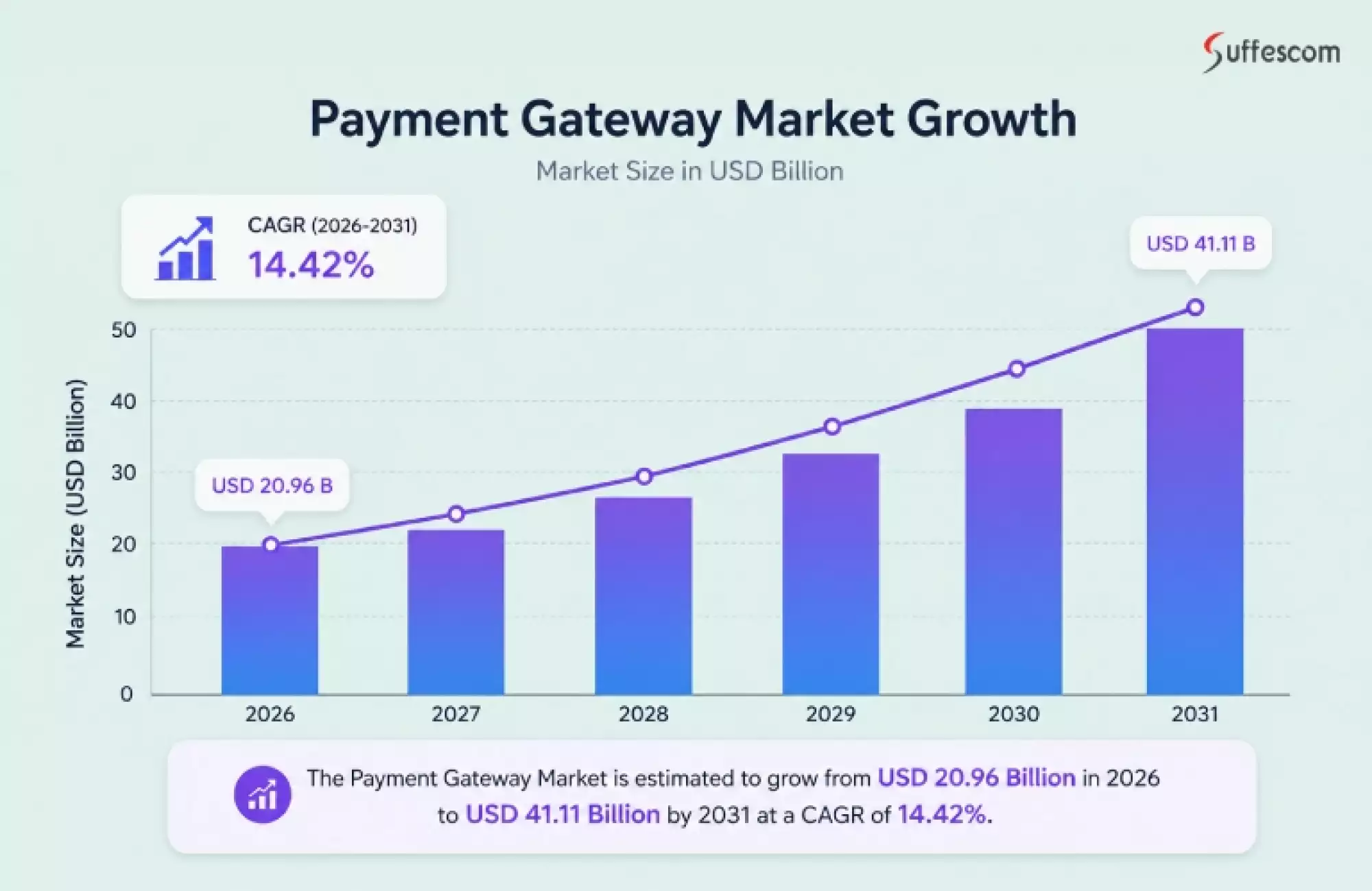
Every second, billions of dollars move across digital networks. It doesn't matter whether a consumer clicks 'Pay Now' in the online shopping cart or an organization pays vendors; the hidden technology behind all of these transactions is the payment gateway. As per Mordor Intelligence, the Payment Gateway Market is estimated to grow to USD 20.96B in 2026, growing to USD 41.11B by 2031 at 14.42% CAGR
But before your development team starts coding your project, one thing should be answered immediately: how much does payment gateway development cost?
The cost may vary between $20,000 for a simple MVP and $120,000 for a robust, compliance-ready payment gateway solution. But such figures are not informative unless you know their background. The actual cost depends on your tech stack, compliance needs, developer's location, desired features, and many other factors.
This guide covers all elements of payment gateway development costs. You'll learn what factors influence these expenses, how to estimate them properly, and what to do to avoid hidden charges. This article is valuable for fintech startups, enterprises that develop proprietary infrastructure, and businesses considering payment gateway integration or development.
What Is a Payment Gateway and Why Build One?
Payment gateways are secure technological layers that authorize and facilitate the transfer of payment data among the customer, merchant, acquiring banks, and issuing banks. This involves an encrypted middleware that enables the processing of transactions by sending confidential card/wallet information using the SSL/TLS protocol for encryption, tokenization, and PCI-DSS-compliant infrastructure.
From a technical standpoint, payment gateways act as transaction engines. These transaction engines capture payment information from checkout systems, encrypt it, and forward it to payment processors/credit card networks (such as Visa, MasterCard, and RuPay). Upon successful validation, a success or failure notification is sent back to the merchant application in milliseconds.
Planning to Build a Secure Payment Gateway?
Get a detailed architecture and cost estimation tailored to your transaction volume, compliance requirements, and business model.
Payment Gateway vs. Payment Processor vs. Merchant Account: Clearing the Confusion
These three terms are often conflated. Understanding the distinction is essential before evaluating payment gateway software development costs.
| Payment Gateway Type | Estimated Development Cost | Best For |
| Simple MVP Payment Gateway | $20,000 – $40,000 | Startups validating payment workflows with basic integrations |
| Mid-Scale Custom Payment Gateway | $40,000 – $60,000 | Growing fintech platforms requiring scalability and advanced features |
| Enterprise-Grade Payment Gateway | $80,000+ | High-volume businesses needing PCI DSS Level 1 compliance, multi-acquirer routing, and global payment support |
Types of Payment Gateway Solutions and Associated Costs
To determine the costs involved in the development of payment gateway software, it is crucial to understand the architecture of the following three payment gateways:
Hosted Payment Gateways: The page for making payments will reside completely on the servers of the third party. Reduced cost associated with software development, but no customization of the look and feel. Examples include PayPal and Stripe Checkout.
API-Based Gateways: The payment information is sent to your server using RESTful APIs and then forwarded to the processor securely. Control over the user experience, high compliance (SAQ D level of PCI DSS), and increased development costs.
Self-hosted/White Label: Own all elements of the system, including connections with the payment processors, token vault, fraud engine, and risk management module.
The Technical Process That Happens Every Time You Pay
Step 1: User starts a payment at checkout – data is collected through a PCI DSS-compliant payment page, hosted iFrame, or direct post.
Step 2: Data is protected using encryption (SSL/TLS) and tokenization of PAN data (token).
Step 3: Payment gateway transmits the encrypted transaction to the acquirer in the form of an ISO 8583 message.
Step 4: Acquiring bank redirects the transaction to the card networks (Visa/Mastercard) and then to the issuing bank.
Step 5: Issuing bank checks for fraud and conducting the cardholder authentication process (3D Secure).
Step 6: Authorization result is returned in milliseconds — typically under 2 seconds — back through the chain to the merchant.
Step 7: Settlement occurs when funds are transferred from the issuing bank to the merchant's account, usually within 1-3 business days.
How Much Does Payment Gateway Development Cost?
The cost to build a payment gateway ranges widely based on complexity, compliance requirements, team location, and feature set. Here's a high-level breakdown:
| Component | Function | Who Owns It |
| Payment Gateway | Encrypts & transmits payment data between customer and bank | Merchant or Third-Party Provider |
| Payment Processor | Moves funds between customer’s bank and merchant’s account | Bank or Payment Network |
| Merchant Account | Holds received funds before transfer to business bank account | Acquiring Bank |
| Issuing Bank | Customer’s bank that approves or declines the transaction | Customer’s Bank |
| Card Network | Sets interchange rules and routes transactions (Visa, Mastercard, RuPay) | Network Association |
These ranges reflect end-to-end payment gateway software development costs, including architecture, security, compliance, testing, and initial deployment. Ongoing maintenance adds 15–25% of development cost annually.
Key Factors That Determine Your Payment Gateway Development Cost
No two payment gateway projects cost the same. The following technical and business variables have the most significant impact on your final budget.
1. Core Feature Set & Functional Scope
The single biggest cost driver is what your gateway needs to do. Here's a feature-level cost breakdown:
| Feature Module | Estimated Development Cost | Complexity |
| User Authentication & KYC (Know Your Customer) | $5,000 – $15,000 | Medium |
| Payment Processing Engine (card-not-present) | $20,000 – $50,000 | High |
| Tokenization & Vault (PAN storage) | $10,000 – $25,000 | High |
| 3D Secure 2.0 (3DS2) Authentication | $8,000 – $20,000 | High |
| Multi-Currency & FX Conversion | $10,000 – $30,000 | Medium-High |
| Recurring Billing & Subscription Engine | $8,000 – $18,000 | Medium |
| Fraud Detection & Risk Scoring Engine | $15,000 – $40,000 | Very High |
| Admin Dashboard & Merchant Portal | $10,000 – $25,000 | Medium |
| Refunds, Chargebacks & Dispute Management | $8,000 – $20,000 | Medium-High |
| Reporting & Analytics Module | $5,000 – $15,000 | Medium |
| Webhook & API Gateway Layer | $5,000 – $12,000 | Medium |
| Mobile SDK (iOS & Android) | $15,000 – $35,000 | High |
The overall cost to build a payment gateway increases significantly when advanced modules such as AI fraud detection, tokenization vaults, and multi-acquirer routing are included.
2. Security Architecture & PCI DSS Compliance Costs
This is the area most cost estimates underplay and most projects overspend on due to poor planning. PCI DSS (Payment Card Industry Data Security Standard) compliance is mandatory for any system that stores, processes, or transmits cardholder data.
- Level 1 PCI DSS compliance preparation and certification may add $20,000 – $50,000 depending on audit scope and infrastructure complexity. (mandatory for gateways that process over 6 million transactions each year)
- QSA Audit: $15,000 - $40,000 yearly
- Penetration Testing: $10,000 - $30,000
- SSL/TLS Infrastructure: $1,000 - $5,000 yearly
- Hardware Security Module Integration: $20,000 - $60,000
- End-to-End Encryption (E2EE): $15,000 - $35,000
- Tokenization System Implementation: $10,000 - $25,000
Security and compliance typically represent 15–25% of the total payment gateway development cost.
3. Third-Party Integrations & Banking Connectivity
A gateway does not operate in isolation. The cost to integrate payment gateway components with external financial infrastructure is substantial:
- Card Network Integration: $10,000 - $40,000 per card network integration (Visa, MasterCard, RuPay, Amex)
- Integration of Acquiring Bank API: $8,000 - $25,000
- Integration of Unified Payment Interface (UPI) (India-based): $5,000 - $15,000
- SWIFT/IBAN integration for international payments: $15,000 - $35,000
- Digital Wallet Integration: $5,000 - $15,000 per digital wallet (Paytm
- Buy Now Pay Later (BNPL) Provider APIs: $8,000 – $20,000
- Open Banking / Account-to-Account (A2A) Payments: $10,000 – $30,000
4. Geographic Reach & Compliance
Every country you conduct business in has different costs of regulation:
- India: RBI PPI standards, PCI DSS, NPCI UPI standards, GST compatibility
- Europe: PSD2, GDPR, SCA, 3DS2
- USA: PCI DSS, SOC 2 Type II, FinCEN AML/KYC regulations, state-based money transmission licensing
- Southeast Asia: MAS (Singapore), Bank Negara (Malaysia), BSP (Philippines) compliance
- Cross-border payment gateway development projects across several regulated jurisdictions may incur additional compliance costs between $15,000 and $40,000.
5. Technology Stack & Infrastructure Architecture
Your technology choices directly impact build time, maintenance cost, and scalability. Here's what our software development company experts recommend for a production-grade gateway:
| Layer | Recommended Technology | Why |
| Backend Core | Node.js / Java / Go | High concurrency, low latency for transaction processing |
| API Layer | REST + GraphQL with OpenAPI 3.0 | Standard interoperability with bank and network APIs |
| Database | PostgreSQL (ACID) + Redis (cache) | ACID compliance critical for financial integrity |
| Message Queue | Apache Kafka / RabbitMQ | Async processing, retry logic for failed transactions |
| Encryption | AES-256, RSA-2048, TLS 1.3 | Industry-standard for PCI DSS compliance |
| Cloud Infrastructure | AWS / GCP / Azure (multi-region) | 99.99% SLA, geographic redundancy |
| Container Orchestration | Kubernetes (EKS/GKE) | Horizontal scaling under peak load |
| Monitoring | Prometheus + Grafana + ELK Stack | Real-time fraud detection and anomaly alerts |
| CDN / DDoS Protection | Cloudflare Enterprise | Real-time fraud detection and anomaly alerts |
6. Development Team Composition & Location
The geography of your development team is one of the most controllable cost variables. Here's the global hourly rate landscape for payment gateway software development:
| Role | USA/Canada ($/hr) | Western Europe ($/hr) | India ($/hr) | Eastern Europe ($/hr) |
| Senior Backend Engineer | $150–$250 | $100–$180 | $25–$60 | $60–$120 |
| Security / PCI Specialist | $200–$350 | $150–$250 | $30–$80 | $80–$150 |
| Frontend / Dashboard Dev | $120–$200 | $80–$150 | $20–$50 | $50–$100 |
| DevOps / Cloud Engineer | $130–$220 | $90–$160 | $22–$55 | $60–$110 |
| QA / Penetration Tester | $100–$180 | $70–$130 | $18–$45 | $45–$90 |
| Project Manager / BA | $100–$160 | $70–$120 | $20–$45 | $50–$90 |
Working together with a seasoned Indian software development firm or an experienced money transfer app development company can cut your overall project cost by up to 40–65% when compared to teams based in the US or Europe, without impacting engineering quality, especially when building fintech and payment infrastructure products.
Build a PCI DSS-Compliant Payment Gateway Faster
From multi-acquirer integrations to AI fraud detection, our fintech engineers help businesses launch enterprise-grade payment systems efficiently.
Custom Payment Gateway Development Cost vs. Third-Party Integration: Full Comparison
One of the most important strategic decisions is whether to build vs. buy. Here's a comprehensive view of the total cost of ownership comparison over 5 years for a business processing 1 million transactions/month:
| Cost Factor | Third-Party Gateway (e.g., Stripe) | Custom Payment Gateway |
| Setup / Integration Cost | $5,000 – $25,000 | $50,000 – $120,000 |
| Per-Transaction Fee | 1.5% – 2.9% + fixed fee | $0.01 – $0.05 (infrastructure only) |
| Annual Fees (1M txns/month) | $80,000 – $120,000/yr | $20,000 – $60,000/yr |
| 5-Year Transaction Cost | $50,000 – $80,000 | |
| Customization Flexibility | Limited by provider | Unlimited |
| Data Ownership | Provider retains raw data | Full ownership |
| PCI DSS Responsibility | Shared / offloaded | Full responsibility |
| Chargeback Control | Limited | Full control |
| Break-Even Point (typical) | N/A | 12 – 30 months |
Payment Gateway Software Development: Phase-by-Phase Cost Breakdown
Understanding the payment gateway software development lifecycle helps you plan budgets milestone by milestone and avoid the hidden costs that derail projects.
Phase 1: Discovery & Architecture Design
Estimated Timeline: 4–8 Weeks
Approximate Cost: $8,000 – $25,000
- Business requirements analysis and payment flow mapping
- Security architecture design (threat modeling, attack surface analysis)
- Regulatory compliance scoping (PCI DSS, RBI, GDPR)
- Technology stack selection and infrastructure blueprint
- API contract design (OpenAPI specification)
- Third-party vendor selection (acquirers, fraud tools, HSM providers)
Phase 2: Core Engine Development (8–20 Weeks | $30,000 – $60,000)
- Payment processing engine with transaction state machine
- Tokenization vault and card data encryption layer
- 3D Secure 2.0 (3DS2) authentication flows
- Acquiring bank and card network API integrations
- Settlement and reconciliation engine
- Webhook delivery system with retry logic
Phase 3: Security & Compliance Implementation (4–10 Weeks | $15,000 – $35,000)
- End-to-end encryption (E2EE) and TLS 1.3 implementation
- HSM integration for key management
- PCI DSS control implementation (all 12 requirement domains)
- Penetration testing and vulnerability assessment
- OWASP Top 10 remediation for payment endpoints
- Fraud scoring model integration (ML-based or rule-based)
Phase 4: Dashboard & Merchant Tools (4–8 Weeks | $10,000 – $25,000)
- Merchant admin portal with transaction monitoring
- Refund and chargeback management interface
- Analytics dashboard with conversion funnel metrics
- API key management and webhook configuration UI
- Settlement reports and financial reconciliation tools
Phase 5: QA, Load Testing & Certification (4–8 Weeks | $15,000 – $35,000)
- Functional testing of all payment flows and edge cases
- Load and stress testing (simulate 10,000+ concurrent transactions)
- Security penetration testing by certified ethical hackers
- PCI DSS QSA audit and report on compliance (ROC)
- Integration testing with all connected bank and network APIs
- Disaster recovery and failover testing
Phase 6: Deployment & Go-Live (2–4 Weeks | $5,000 – $20,000)
- Multi-region cloud deployment with Kubernetes orchestration
- CI/CD pipeline setup for zero-downtime deployments
- Monitoring stack configuration (APM, alerting, SIEM)
- Production traffic migration with shadow mode testing
- Support runbook and incident response documentation
Ongoing Maintenance & Operational Costs After Launch
Many businesses underestimate ongoing operational expenses when calculating how much a payment gateway costs beyond the initial development phase. The build cost is only part of the story. Here's what to budget for post-launch payment gateway operations:
| Operational Cost Category | Annual Cost Estimate |
| Cloud Infrastructure (AWS/GCP/Azure) | $24,000 – $120,000 |
| PCI DSS Annual Re-Certification (QSA) | $15,000 – $40,000 |
| Security Penetration Testing (bi-annual) | $20,000 – $60,000 |
| Software Maintenance & Feature Updates | $30,000 – $100,000 |
| Fraud Detection Tool Subscriptions | $12,000 – $48,000 |
| Card Network Membership Fees | $5,000 – $25,000/year |
| Customer Support & Ops Team | $20,000 – $80,000 |
| Incident Response & Monitoring | $10,000 – $30,000 |
Wondering How Much Does Payment Gateway Cost for Your Business?
Get a personalized estimate based on features, compliance scope, banking integrations, and transaction scale.
Build or Buy or White-Label Payment Gateway? Triangular Cost-Benefit Comparison Matrix
Many pieces compare building vs. using the Stripe payment gateway. This comparison misses one more critical aspect, that of the white-label payment gateway solution that has become increasingly popular lately. Being aware of all three aspects of the payment gateway question can help you make a wise decision. For businesses processing high transaction volumes, the long-term cost to build a payment gateway may become lower than recurring third-party transaction fees.
Specifics of Each Alternative
Build: You get full control since you will own the whole code of the transaction engine, fraud prevention mechanism, compliance tooling, and user interface. However, this is also the most expensive option.
Buy: You integrate an external provider such as Stripe or RazorPay using an API or hosted checkout. Launch takes time; however, you will pay per-transaction fee that will increase over time.
White-Label: You acquire an existing fully functioning payment gateway system, change its UI, and brand it to your liking.
| Decision Factor | Build (Custom) | Buy (Third-Party) | White-Label |
| Upfront Cost | $20,000 – $120,000 | $100 – $5,000 | $15,000 – $80,000 |
| Time to Launch | 3 – 24 months | Days to weeks | 4 – 10 weeks |
| Transaction Fees | Interchange only (~0.3–0.5%) | 2.5% – 3.5% + flat fee | Low licensing fee + low per transaction |
| Branding Control | Full custom | Limited / provider branded | Full white-label brand |
| PCI DSS Ownership | You own it entirely | Provider manages most | Shared with licensor |
| Customization Depth | Unlimited | API-level only | Feature-level (within platform) |
| Scalability | Unlimited — you architect it | Provider-set limits | Platform ceiling may apply |
| IP Ownership | 100% yours | None | Licensed (not owned) |
| Best For | Fintech platforms, high-volume enterprises | Startups, SMBs, fast MVP | Mid-market, PSPs, SaaS platforms |
How to Lower Payment Gateway Development Costs Without Compromising Quality
If you're evaluating how much does payment gateway costs, the right architectural decisions and infrastructure strategy can significantly reduce expenses without compromising security, scalability, or compliance.
Use Off-the-Shelf Tokenization Vaults
Rather than coding your tokenization vault yourself, leverage a PCI DSS-compliant Software-as-a-Service (SaaS) vault ($500–$5,000/mo). You eliminate the most costly scope of compliance while retaining your proprietary code.
Launch With Few Integrations
Go live with 2–3 critical payment systems instead of all possible integrations. Your MVP approach will shave 30–40% off of your time-to-launch while delaying the integration budget until it’s warranted by revenue.
Rely on an Open Source Core
Payment frameworks such as Hyperswitch (an open source payment switch) will give you the basic transactional routing layer. Leveraging an extensively vetted OSS foundation can cut backend development costs by 30–50%.
Outsource Senior Engineering, but Not Compliance
Take advantage of cheaper offshore software engineers for core development (40–65% savings) while keeping your PCI QSA and compliance lawyers onshore or local to your target market. This mixed approach provides the best quality-to-cost balance.
Build Infrastructure as Code from the Start
Starting with Terraform + Kubernetes + GitOps from the get-go saves you 40% on DevOps and makes PCI DSS evidence collection for audits (mandated by PCI) trivially easy.
Emerging Technologies Reshaping Payment Gateway Development
The following list includes technologies changing the face of modern payment gateway software development. Here's how much these innovations cost and why you might want to consider implementing them:
AI-based Fraud Detection Systems
Rule-based fraud detection systems have been superseded by AI models that leverage transactions’ behavioral patterns. The cost of developing an AI-based fraud detection tool varies from $20,000 to $60,000; it will assist organizations in minimizing their fraud-related losses by 30%–70%. The most prevalent approaches are XGBoost, LightGBM, neural networks, and anomaly detection methods such as autoencoders.
Account-to-Account (A2A) & Open Banking Payments
To avoid expensive card network processing fees, businesses should implement payment flows that bypass credit/debit card issuers and directly access their customers' banking accounts via Open Banking APIs. Developing such a gateway will take you from $15,000 to $45,000, but it will save you money.
Blockchain and Stablecoins
As businesses try to improve the efficiency and speed of cross-border transactions, they implement blockchain and stablecoin settlement options. Implementing CBDC and stablecoins in addition. Building a crypto payment rail alongside a fiat gateway adds $30,000–$80,000 in development cost.
Biometric & Passwordless Authentication
Using biometric WebAuthn/FIDO2 over two-factor authentication based on one-time passwords (2FA) enhances security while minimizing friction for users. It will incur extra expenses of up to $8,000-$20,000 during the development of the gateway.
How to Choose the Right Payment Gateway Software Development Partner
Your technology partner choice has an outsized impact on project success. Here are the critical evaluation criteria:
Non-Negotiable Technical Credentials
- Demonstrated PCI DSS Level 1 project experience with client references
- Hands-on experience with card network certification processes (Visa/Mastercard)
- Proven fintech portfolio : look for live, processing payment products, not demos
- Security-first engineering culture with OWASP, SAST/DAST tooling in their SDLC
- Experience with high-availability distributed systems (Kubernetes, microservices)
Red Flags to Watch For
- Fixed-price contracts with no scope for compliance discoveries
- Teams without dedicated security or fintech specialists
- Lack of experience with your target regulatory jurisdiction
- No mention of threat modeling or penetration testing in their process
- Inability to provide references from live payment product clients
Engagement Model Recommendations
- Discovery Phase First: Invest $8,000–$20,000 in a scoping engagement before committing to full build
- Milestone-Based Payments: Tie payments to working, testable deliverables
- Escrow for IP: Ensure source code escrow is written into the contract
- Compliance Co-Ownership: Your QSA should have direct access to the development team
FAQs
1. How much does a payment gateway cost for a startup?
A startup-level MVP payment gateway typically costs $30,000 – $80,000. This covers basic card processing, a simple merchant dashboard, PCI SAQ D compliance (self-assessment), and integration with one acquiring bank. The timeline is typically 3–5 months with a team of 4–6 engineers.
2. What is the custom payment gateway development cost for an enterprise?
Enterprise-grade gateways with multi-currency support, AI fraud detection, multi-acquirer routing, and full PCI DSS Level 1 certification cost $50,000 – $100,000+. If you're also building, acquiring infrastructure, or supporting regulated money movement, costs can exceed $120,000.
3. How long does it take to build a payment gateway?
A basic gateway MVP takes 3–5 months. A mid-tier gateway with fraud detection and multi-currency support takes 6–10 months. An enterprise gateway with full compliance certification can take 12–18 months. PCI DSS certification alone typically takes 3–6 months to complete.
4. Can I integrate an existing payment gateway instead of building one?
Absolutely. For businesses below $2M/month in GMV, third-party gateway integration ($5,000 – $30,000) is almost always the smarter choice. The cost to integrate a payment gateway is dramatically lower than building one. Our software development company can handle both integration and custom builds, depending on your scale and needs.
5. What is PCI DSS, and why does it matter for payment gateway cost?
PCI DSS (Payment Card Industry Data Security Standard) is the mandatory security standard for any system handling card data. Level 1 certification (for high-volume gateways) costs $50,000 – $100,000 and requires annual recertification. Non-compliance can result in fines of $5,000–$100,000/month from card networks and loss of the ability to process cards entirely.
6. What ongoing costs should I budget for after building a payment gateway?
Plan for 20–25% of your initial development cost annually in ongoing costs. For a $100,000 gateway, that's $20,000–$30,000/year covering cloud infrastructure, PCI re-certification, security testing, feature updates, and fraud tool subscriptions before any team headcount.