+971-8000321216



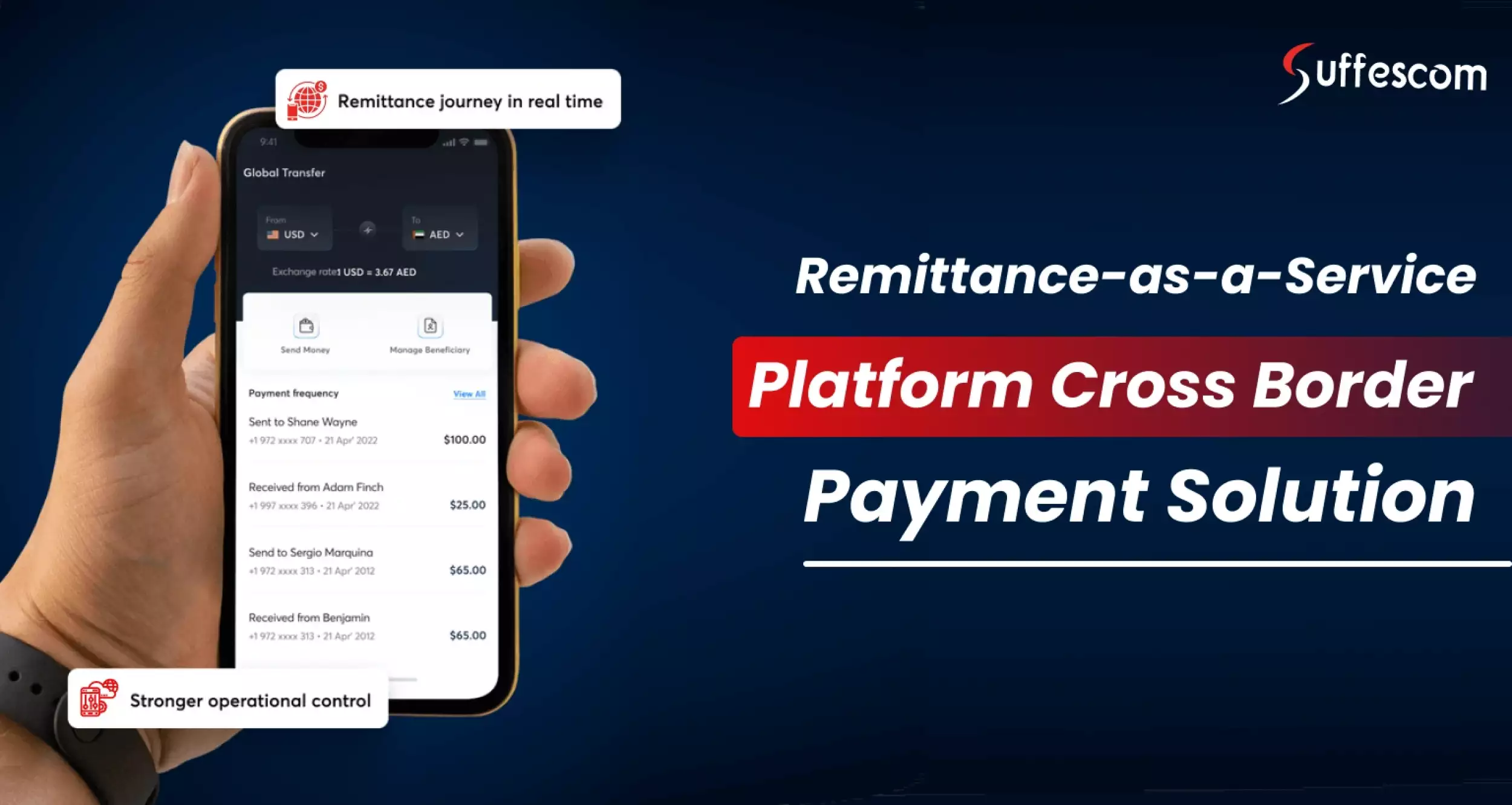
Global money movement is no longer limited to banks and long processing times. Today, businesses & consumers expect instant, secure, as well as digitally driven cross-border transactions that work seamlessly across devices & regions. This trend demands flexible remittance solutions to streamline daily money transfer operations.
According to reports, Remittance-as-a-Service (RaaS) platforms are emerging as a game-changing solution for NBFIs and fintech companies looking to enter or expand in the global payments space. These solutions help financial institutions accelerate time-to-market plus offer a seamless money-transfer experience.
By partnering with a trusted remittance-as-a-Service development company, NBFIs & fintech firms can build a scalable remittance ecosystem that is ready to grow across multiple regions while meeting evolving customer expectations.
So, stay tuned to explore how we help businesses build scalable remittance solutions!
Accelerate NBFC Growth with Custom Remittance Solutions!
About the Top-Rated Global Remittance Platform in 2026
Remittance-as-a-Service (RaaS) platform development is the process of building API-driven, cloud-based systems that enable businesses to offer cross-border money transfer services with built-in compliance, multi-currency support, and real-time processing.
It provides the essential infrastructure along with capabilities required to handle global remittances efficiently, consisting of:
- Cross-border payment processing
- Multi-currency transaction support
- Built-in compliance as well as KYC workflows
- Secure transaction management
- Integration with banks & payment networks
- Flexible configuration based on business requirements
For B2B clients such as fintech companies, NBFCs, payment providers, along with financial institutions, a RaaS platform simplifies entry into the remittance market while reducing development time, operational challenges, as well as technical overhead.
How a Remittance-as-a-Service Platform Works?
Explore the step-by-step working process of RaaS software solutions for cross-border payment:
1. Customer Initiates a Transfer
The platform allows end-users (customers) to log into your app or system by entering:
- Recipient details
- Amount to send
- Destination country
The software captures all these details, plus requests & sends them to the RaaS system.
2. Verification & Compliance Check
Before processing the request, the system performs:
- KYC (Know Your Customer) verification
- AML (Anti-Money Laundering) checks
This makes sure your business stays compliant with financial regulations.
3. Exchange Rate & Fee Calculation
Once the verification is done, the system:
- Fetches real-time currency exchange rates
- Calculates transfer fees
The user sees the exact amount the receiver will get before confirming.
4. Payment Collection
The sender pays using commonly available U.S. payment methods, such as:
- Bank transfer (ACH)
- Debit or credit cards
- Direct bank account linking
The platform securely collects, as well as confirms, the payment before initiating the transfer.
5. Transaction Processing
Once payment is confirmed:
- The RaaS system routes the money through its network
- Connects with partner banks or payment providers
This is the step where the actual cross-border transfer happens.
6. Payout to Receiver
The recipient receives funds through commonly used U.S. payout methods, such as:
- Direct bank deposit (ACH credit)
- Debit card deposit (instant or same-day)
- Cash pickup through authorized payout partners
The platform ensures secure, timely & reliable delivery of funds based on the selected payout option.
7. Tracking & Notifications
At this step, business & end-users can:
- Track transaction status with real-time updates
- Receive alerts via SMS, email, or in-app notifications
- Get clear visibility into transfer progress and completion
8. Admin Monitoring
On the business side, the platform provides a centralized dashboard to:
- Monitor & manage all transactions in real time
- Oversee user activity and account management
- Access audit logs & compliance reporting
This assists in generating insights through performance analytics along with reporting tools.
The Rising Demand for Remittance-as-a-Service (RaaS) Platforms: Key Drivers Explained
Remittance-as-a-Service (RaaS) platforms are gaining strong traction as financial institutions & fintech businesses look for faster ways to enter the global money transfer market. Remittance-as-a-service development for NBFCs simplifies cross-border payments while unlocking new revenue streams. Here are the key reasons behind this growing demand:
1. Expanding Global Remittance Market: The cross-border payment industry is expanding rapidly, driven by globalization, rising digital adoption & a migrant workforce. Conventional cash-based transfers are steadily being replaced by mobile as well as digital channels. This creates a strong opportunity for businesses to tap into a high-volume, high-demand market through RaaS platforms.
2. Strong Monetization Opportunities: These systems allow several revenue streams from the start. Businesses can earn through:
- Transaction fees
- Foreign exchange margins
- Service charges
- Third-party partnerships
This diversified monetization model makes it highly attractive for fintech startups and banks, as well as NBFCs, looking to maximize ROI.
3. Built for Global Scalability: A major advantage of RaaS is its ability to support multi-country operations. These platforms are designed to handle numerous
- Currencies
- Languages
- Regulatory requirements
This makes it easier for businesses to expand internationally without major infrastructure changes.
4. Seamless API-Driven Integrations: Modern RaaS platforms are built on an API-first architecture that permits smooth integration with:
- Banks
- Payment gateways
- Digital wallets
- Foreign exchange providers
This flexibility makes sure businesses can easily plug into existing financial ecosystems, plus boost their service offerings.
5. Compliance-Ready Infrastructure: Regulatory compliance is a main challenge in cross-border payments. API-based Remittance Solutions equipped with
- Built-in compliance frameworks (KYC (Know Your Customer) and AML (Anti-Money Laundering))
- Data security protocols
This helps businesses operate confidently across different regions while reducing legal risks.
6. Increasing Competitive Pressure: With the rapid growth of digital remittance providers, competition is intensifying. Businesses are adopting RaaS platforms to stay competitive and launch faster, as well as offer better user experiences without investing heavily in core infrastructure development.
Key Challenges in RaaS Platform Development
The following are the most critical challenges businesses must address:
1. Regulatory Complexity: Cross-border payments are subject to strict and evolving regulations across countries.
- Managing KYC & AML compliance
- Adhering to regional financial laws and licensing
- Ensuring data protection (GDPR and local regulations)
Impact: Non-compliance can lead to penalties, legal risks, and service disruptions.
2. Liquidity Management: Maintaining sufficient funds across multiple corridors is a major operational challenge.
- Managing pre-funded accounts in different countries
- Balancing liquidity in real time
- Avoiding transaction failures due to insufficient funds
Impact: Poor liquidity management can delay transactions and affect service reliability.
3. Foreign Exchange (FX) Volatility: Currency fluctuations directly impact transaction value and business margins.
- Handling real-time exchange rate changes
- Managing FX risks across corridors
- Maintaining competitive yet profitable pricing
Impact: Inefficient FX handling can reduce profitability and user trust.
4. Fraud & Security Risks: Remittance platforms are highly vulnerable to fraud and cyber threats.
- Detecting suspicious transaction behavior
- Preventing identity theft and account misuse
- Securing sensitive financial and user data
Impact: Security breaches can result in financial losses and reputational damage.
5. Integration Challenges: RaaS platforms rely on multiple third-party integrations.
- Connecting with banks, payment gateways, and FX providers
- Managing API compatibility and uptime issues
- Handling failures across interconnected systems
Impact: Poor integrations can lead to failed transactions and an inconsistent user experience.
Discuss Your Cross-Border Payment Requirements with Experts Today!
Powerful Features That Make RaaS Platforms Stand Out
The remittance-as-a-Service Development Service comes with the following top-rated functionalities:
1. Intelligent Routing for Cost & Speed Optimization
Modern RaaS systems do not just send money; they choose the smartest path for each transaction. They automatically route payments through the most efficient partner (bank, wallet, or network) based on:
- Exchange rates
- Currency
- Transfer speed
- Corridor performance
This allows businesses to overcome operational expenses while improving delivery times.
2. Real-Time Liquidity & Treasury Management
The money transfer app development solutions have the ability to automate liquidity management across corridors to make sure:
- Funds are available in different countries
- Pre-funded accounts are balanced in real time
This not only decreases the need for manual treasury operations but also prevents transaction delay.
3. White-Label & Multi-Tenant Architecture
Unlike basic systems, RaaS platforms often support white-label solutions (launched under your brand) and multi-tenant environments (serving multiple clients from a single system). This helps organizations that want to:
- Offer remittance as a service to other businesses
- Scale without building separate infrastructures
4. Advanced Fraud Detection with AI/ML
The system is integrated with multi-layer security beyond basic compliance checks that help the system:
- Detects unusual transaction patterns
- Flags high-risk users or corridors
- Continuously learns from transaction data
This proactive approach decreases the chances of fraud in cross-border payments.
5. Dynamic FX Engine with Margin Control
Instead of just showing exchange rates, advanced RaaS platforms offer dynamic FX pricing engines, along with configurable markup/margin controls. This allows businesses to:
- Adjust margins per corridor or customer segment
- Maximize profitability without affecting competitiveness
- Define service levels based on transaction type
- Easily configure tax slabs
6. Hyper-Personalized User Experience Layer
Experts build a comprehensive model for remittance-as-a-service that enables businesses to customize the experience based on user behavior, transaction history & geography. This consists of:
- Smart suggestions (frequent recipients, repeat transfers)
- Localized UI/UX
- Personalized fee structures
7. Embedded Finance Capabilities
A key differentiator is the ability to embed remittance into other platforms, such as:
- E-commerce apps
- Payroll systems
- Gig economy platforms
This turns remittance into a value-added feature rather than just a standalone service.
8. Real-Time Settlement & Instant Payout Rails
Some advanced RaaS platforms integrate with instant payment networks, enabling:
- Near real-time settlement
- Faster payouts across supported regions
This dramatically improves customer satisfaction, as well as competitive positioning.
9. Data Analytics & Business Intelligence Layer
Beyond basic reporting, modern remittance as a service software provides predictive analytics and corridor performance insights, along with customer behavior tracking. This helps financial organizations:
- Optimize pricing strategies
- Identify high-growth markets
- Improve decision-making
10. Modular & Microservices-Based Architecture
Unlike monolithic systems, advanced RaaS solutions are built using microservices architecture & modular components that allow businesses to:
- Scale-specific features independently
- Add new services without disrupting operations
A Win-Win Model: How RaaS Transforms Business & User Journeys
Businesses Benefits
1. Multi-Currency Support: Helps businesses operate across multiple countries without building separate systems. It simplifies managing different currencies plus enables smooth expansion into global markets.
2. Admin & Dashboard Controls: Provides a centralized system to manage transactions, fees, settlements, and disputes, as well as partners, improving operational efficiency & control.
3. Transfer Options (Express or Economy): This feature enables companies to design various pricing structures depending on transfer speed. In fact, it is an aid to addressing multiple client needs while increasing revenue possibilities.
4. Real-Time Tracking & Notifications: Provides complete transparency about the transaction status. That makes it possible to monitor more closely, respond to issues faster & enhance the overall level of business openness.
5. Multi-Payment Integration: The solution allows expansion of the business network by collaborating with banks, wallets, and cash points. This enables offering services in various regions and channel combinations.
6. Analytics & Insights: Offers the opportunity to understand clients' behavior through analytical data, to optimize pricing, and to choose the best corridors for decision-making.
7. API and Third-Party Integration: Enables seamless integration with systems like CRM, ERP, payment gateways, and fintech tools while supporting efficient fintech software integration for automated workflows, faster operations, and improved business efficiency.
8. Mobile-First UI/UX: Attracts more users & increases retention by offering a smooth, user-friendly mobile experience.
9. Loyalty Programs & Referral Incentives: This is a way to both acquire & keep customers by motivating them to not only come back for more but also even refer others. This actually increases the business value over the long term.
10. Flexible Fee Models: Facilitate varied pricing strategies based on geography, transaction type, or even customer segments, with the aim of enhancing profitability.
11. Global Scalability: Aids in entering new markets without major reconfigurations of the system, thereby continuing to support business growth in the future.
End User Benefits
1. Different Currency Transfer: Allows users to send and receive money in different currencies with accurate exchange rates, making international transfers simple.
2. Transfer Options (Express or Economy): Gives users the flexibility to choose between fast transfers or lower-cost options based on their needs.
3. Safe & Secure Transactions: Provides a safe, verified environment where users can trust that their transactions comply with applicable regulations.
4. Real-Time Popups: Keep users informed with instant updates on their transaction status, reducing uncertainty.
5. Multi-payment Modes: Offers flexibility to send or receive money through banks, wallets, or cash pickup, based on user preference.
6. Advanced Fraud Detection: Ensures that personal and financial data is protected, making transactions safe and reliable.
7. Reliable Service Experience: Improves consistency and service quality through data-driven system optimization.
8. Cross-Platform Convenience: Allows users to access and manage transfers through apps or integrated platforms for a seamless experience.
9. Easy Mobile Experience: Provides a simple, intuitive interface, making it easy to send money anytime, anywhere.
10. Rewards & Incentives: Offer benefits such as discounts, bonuses, and referral rewards, making the platform more engaging.
11. Quick Platform Availability: Provides users with a stable, functional platform without long wait times after launch.
12. Transparent Fees: Ensure all pricing is transparent & easily understood so users are aware of what they will pay before making any transaction.
13. Global Accessibility: Enables users to send money to many countries through a single platform, without the hassle of switching platforms.
A Quick Comparison: RaaS vs Traditional Remittance
Below is a detailed comparison to help you understand how the Remittance as a Service platform stands apart.
| Parameter | Remittance-as-a-Service (RaaS) | Traditional Remittance |
| Definition | A cloud-based platform that enables businesses to integrate & manage remittance services via APIs | Conventional money transfer systems operated by banks or financial institutions |
| Technology | API-driven, cloud-native, AI-enabled systems | Legacy infrastructure, often manual or semi-digital |
| Transaction Speed | Near real-time or instant transfers | Takes 1–5 business days, depending on corridors |
| Cost Efficiency | Lower operational & transaction costs due to automation | Higher fees due to intermediaries & manual processing |
| Scalability | Highly scalable and flexible for growing businesses | Limited scalability; expansion requires heavy infrastructure |
| Integration | Easy integration with apps, wallets, and fintech platforms | Difficult & time-consuming integrations |
| User Experience | Seamless, digital-first, user-friendly interfaces | Often complex and less intuitive processes |
| Compliance & Security | Built-in compliance tools (KYC/AML automation, AI monitoring) | Manual compliance checks, higher risk of delays |
| Global Reach | Wide global coverage through partnerships and APIs | Limited to bank networks and partnerships |
| Customization | Highly customizable as per business needs | Minimal customization options |
| Transparency | Real-time tracking & a clear fee structure | Limited visibility on fees and transfer status |
| Maintenance | Managed by service providers (low maintenance) | Requires continuous upgrades and maintenance |
| Time to Market | Faster deployment (weeks as per need) | Slow deployment (months or years) |
| Innovation | Supports AI, blockchain & advanced analytics | Limited innovation due to outdated systems |
| Business Model | Subscription or usage-based (pay-as-you-go) | Fixed cost-heavy models with operational overhead |
Top Use Cases & Industry Applications of RaaS Systems
Let's explore how multiple industries now rely on RaaS to streamline global transactions:
1. Fintech Startups & Digital Wallets
Fintech companies integrate RaaS APIs to enable instant international money transfers within their apps. Helps to:
- Launch remittance features quickly without building infrastructure
- Offer multi-currency wallets
- Provide real-time transfers and tracking
For instance, mobile wallet apps enable users to send money globally in seconds.
2. Banks & Financial Institutions
Traditional banks adopt RaaS to modernize legacy remittance systems.
- Reduce operational costs
- Automate compliance (KYC/AML)
- Improve transaction speed
This helps banks stay competitive with fintech disruptors.
3. E-commerce & Online Marketplaces
Platforms use RaaS to pay international sellers as well as vendors. It results in:
- Fast cross-border vendor payouts
- Currency conversion automation
- Transparent fee structures
Example: Global marketplaces paying sellers in their local currencies.
4. Cryptocurrency & Blockchain Platforms
Crypto platforms integrate RaaS for fiat-to-crypto and cross-border transfers. How it helps:
- Faster global settlements
- Lower transaction costs
- Enhanced transparency
5. Gig Economy & Freelance Platforms
Freelance platforms use RaaS to pay remote workers worldwide.
- Instant or scheduled payouts
- Reduced transfer fees
- Better worker satisfaction
For instance, platforms like Upwork & Fiverr are leveraging global payment systems.
6. Payroll & HR Tech Platforms
Companies with global teams use RaaS for cross-border payroll processing. This assists with:
- Automated salary disbursement
- Multi-currency payroll management
- Compliance with local regulations
This is how the Raas system development solutions simplify global workforce management.
7. Remittance Service Providers
Money Service Businesses (MSBs) use RaaS to expand their global network.
- Quick entry into new markets
- Reduced dependency on intermediaries
- Scalable remittance infrastructure
8. Gaming & Digital Content Platforms
Gaming companies use RaaS to pay global creators and streamers. How it helps:
- Instant payouts
- Multi-currency support
- Better engagement with creators
9. NGOs & Humanitarian Organizations
Non-profits use RaaS to send funds to beneficiaries across countries. This permits:
- Quick fund disbursement in crisis situations
- Reduced leakage and fraud
- Transparent tracking of funds
The Tech Architecture Behind Successful Remittance Platforms
We utilize the top-rated technologies to build scalable & resilient Remittance software:
| Technology Layer | Technologies / Tools | Purpose of the RaaS Platform |
| Frontend (Web & Mobile) |
| Used to build user-facing apps (web & mobile) with smooth UI/UX for sending money, tracking transfers & managing accounts. |
| Backend Development |
| Handles core business logic like transaction processing, authentication, API handling, and system workflows. |
| API & Integration Layer |
| Connects with banks, payment gateways, FX providers, and third-party services for seamless transactions. |
| Databases (Primary) |
| Stores financial data, user accounts & transactions with high consistency (ACID compliance). |
| Databases (NoSQL & Caching) |
| Handles high-speed data access, caching, and unstructured data for real-time performance. |
| Real-Time Processing |
| Enables instant transaction updates, event streaming, and real-time notifications. |
| Cloud Infrastructure |
| Provides scalable, secure, and globally available infrastructure for handling millions of transactions. |
| Containerization & DevOps |
| Ensures scalable deployment, automation, and smooth updates without downtime. |
| Security Technologies |
| Protects user data, secures transactions, and prevents unauthorized access. |
| Compliance & KYC/AML Tools |
| Automates identity verification and regulatory compliance for global operations. |
| Payment & Banking Integration |
| Enables fund transfers, bank connectivity, and payment processing across regions. |
| Digital Wallet & Ledger System |
| Tracks balances, transactions, and internal fund movements accurately. |
| Fraud Detection & AI/ML |
| Detects suspicious activities, prevents fraud, and improves risk management. |
| Blockchain (Optional but Advanced) |
| Used for faster cross-border stablecoin payment settlement, transparency, and reduced intermediaries. |
| Monitoring & Analytics |
| Tracks system performance, logs, and transaction analytics in real time. |
| Notification Services |
| Sends real-time alerts via SMS, email, and push notifications. |
| Data Analytics & BI Tools |
| Helps businesses analyze transaction trends, user behavior, and revenue insights. |
A Step-by-Step Process to Build a Remittance-as-a-Service Platform
Explore how skilled developers turn your idea of creating a powerful Remittance-as-a-Service platform into reality:
Step 1: Business & Requirement Analysis
This step sets the foundation for the entire system. Here, the team of experts understands what type of remittance platform you want to build. To do so, they define:
- Target countries (corridors)
- User types (individuals, agents, businesses)
- Revenue model (fees, FX margins, commissions)
Step 2: Compliance & Regulatory Planning
It is the most important step, as experts make sure the platform they are building aligns with financial regulations. To avoid legal risks & smooth operations globally, they plan for:
- KYC (Know Your Customer) workflows
- AML (Anti-Money Laundering) checks
- Licensing requirements for different regions
Step 3: System Architecture Design
Under this step, engineers start designing the technical structure of the Remittance-as-a-Service platform. A strong architecture ensures scalability, security, and performance; thus, choosing a powerful tech stack is significant. Experts include:
- Backend architecture (microservices or monolithic)
- Database structure
- API architecture
Step 4: UI/UX Design (Web & Mobile)
After deciding on the technologies, the development process begins with the UI/UX design. The team of experts built a simple, user-friendly interface for both web and mobile apps so that not only platform owners but also users can use it smoothly without any hassle. As good design improves user adoption, along with retention, during the design process, they focus on:
- Easy onboarding
- Smooth money transfer flow
- Clear transaction tracking
Step 5: Core Backend Development
This is where the actual remittance functionality is developed. The engineers begin building the platform's core engine, which consists of:
- User authentication & account management
- Wallet and ledger system
- Transaction processing logic
Step 6: Payment & Banking Integrations
This step permits the movement of real money across borders. Here, developers integrate the platform with top
- Banks
- Payment gateways
- FX providers
- Payout partners
Step 7: Compliance & Security Implementation
Keep the platform safe, compliant, as well as trustworthy. Our experts added security layers such as:
- Data encryption
- Fraud detection systems
- Secure APIs
- KYC/AML automation
Step 8: Real-Time Features & Notifications
To enhance transparency & user experience, mobile developers build real-time capabilities, such as:
- Transaction tracking
- Status updates
- Alerts via SMS, email, or app
Step 9: Admin Panel & Reporting Tools
To hand over the full system control, along with optimizing operations, a powerful backend dashboard is developed that helps:
- Monitor transactions
- Manage users &agents
- Generate reports and analytics
Step 10: Testing & Quality Assurance
Once the development is finished, a QA team tests the system to evaluate whether it is bug-free or functions properly. The following types of testing are performed to evaluate the capabilities of the Remittance-as-a-Service Platform.
- Functional testing
- Security testing
- Load testing
Step 11:Deployment & Launch
This is where the platform becomes ready for real users. After testing, if the system works well, it is deployed on cloud infrastructure and made live. During the deployment, experts make sure:
- Smooth rollout
- System monitoring
- Backup and recovery setup
Step 12:Ongoing Support & Upgrades
To keep the Remittance as a Service system competitive as well as future-ready, experts provide post-launch support, which includes:
- Performance monitoring
- Feature upgrades
- Compliance updates
How Much Does It Cost to Build a P2P Money Transfer App?
This pricing reflects a cost-efficient development approach, where businesses leverage pre-built infrastructure, third-party APIs (payments, KYC, FX), as well as modular development. Look at the following Remittance-as-a-Service development cost breakdown:
| Cost Component | Basic Platform | Mid-Level Platform | Advanced Platform |
| Planning & Compliance Setup | $2,000 to $4,000 | $4,000 to $7,000 | $7,000 to $10,000+ |
| UI/UX Design | $1,500 to $3,000 | $3,000 to $6,000 | $6,000 to $10,000+ |
| Core Platform Development | $6,000 to $10,000 | $10,000 to $15,000 | $15,000 to $20,000+ |
| Payment API Integrations | $3,000 to $5,000 | $5,000 to $8,000 | $8,000 to $12,000+ |
| KYC/AML Integration | $2,000 to $4,000 | $4,000 to $6,000 | $6,000 to $10,000+ |
| Security & Fraud Controls | $1,500 to $3,000 | $3,000 to $5,000 | $5,000 to $8,000+ |
| Admin Dashboard | $1,500 to $3,000 | $3,000 to $5,000 | $5,000 to $8,000+ |
| Testing & QA | $1,500 to $3,000 | $3,000 to $5,000 | $5,000 to $7,000+ |
Why Partner with Suffescom for Remittance-as-a-Service Software Development?
As the trusted Remittance-as-a-Service development company, we
1. Proven Fintech Development Expertise: We have years of experience building secure, scalable fintech solutions, particularly in payment & remittance systems.
2. End-to-End Development Support: From AI idea validation to deployment & post-launch support, our team of expert developers handles the complete development lifecycle.
3. Custom-Built Solutions for Your Business: We do not believe in a one-size-fits-all approach. Our team completely understands that every business has unique requirements and requires a tailored approach to compete in the market.
4. Dedicated Team That Understands Your Business Goals: You do not just get developers, you get a team that listens, plans & aligns the product with your long-term business vision.
5. Expertise in Handling Complex Workflows: Remittance platforms involve multiple steps, such as currency conversion, transaction tracking & compliance checks. Our experts are skilled in managing these complex flows smoothly.
Speed Up Your Fintech Growth with a Powerful Remittance Solution!
FAQs
1. How does a RaaS platform work?
The system connects banks, payment gateways & financial networks through APIs. When a user sends money, the platform processes the transaction, converts currency if needed, and delivers funds securely to the recipient.
2. How much does it cost to develop a RaaS platform?
The cost to build RaaS software ranges from $15,000 to $45,000+. This range can fluctuate depending on required features, integrations, compliance requirements, as well as the level of customization.
3. What are the key features of a RaaS platform?
The following are the key capabilities of the RaaS platform:
- KYC/AML verification
- Multi-currency support
- Real-time tracking
- Payment gateway integration
- Fraud detection
- Admin dashboard
4. How long does it take to build a remittance platform?
The development time may vary as per the project requirements & scope. Generally, a basic-level RaaS platform takes 3 to 6 months for completion. However, if you want to build an enterprise-grade system, it may take 12+ months to finish.
5. Is regulatory compliance included in RaaS platforms?
Absolutely! We build a RaaS platform with built-in compliance features, including KYC, AML, GDPR & local financial regulations.
6. Can the platform support multiple currencies?
Of course! Multi-currency support is a core feature of the RaaS system. It allows users to send and receive money in different currencies with real-time exchange rates.
7. How secure is a RaaS platform?
The system is fully secured, as it uses advanced security measures like:
- End-to-end encryption
- Two-factor authentication
- Fraud monitoring systems
8. What does RaaS do?
- Enables global money transfer
- Automates compliance (KYC/AML)
- Supports multi-currency payments
- Integrates via APIs
9. Is it possible to scale the platform as the business grows?
Of course! RaaS platforms are built on scalable cloud infrastructure. This allows businesses to handle increased transaction volume.
10. Can the platform support mobile & web applications?
Absolutely! RaaS platforms are designed to support both mobile apps and web applications for better user accessibility.
11. How to choose the right RaaS development partner?
When it comes to choosing the Raas system development company, you must look for the following parameters:
Experience in fintech development
- Strong security practices
- Knowledge of compliance regulations
- Customization capabilities
- Post-launch support
For more information, contact experts at Suffescom.